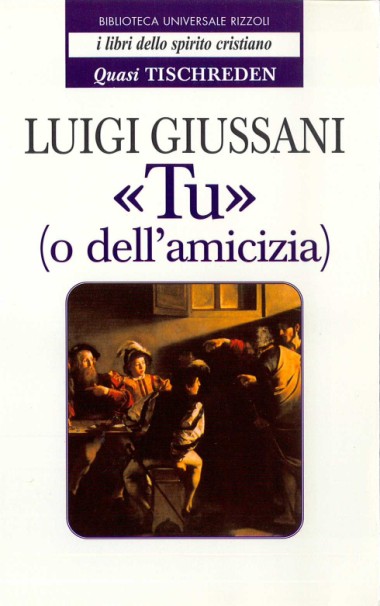
Giussani, Luigi. «Tu» (o dell’amicizia): Volume primo. I libri dello spirito cristiano: Quasi Tischreden. Milano: Biblioteca Universale Rizzoli, 1997.

«Tu» (o dell'amicizia): Volume primo
Giussani Luigi  Author

BUR Italian 1997 Pages: 380

Latest update
05/06/2025


Giussani, Luigi. «Tu» (o dell’amicizia): Volume primo. I libri dello spirito cristiano: Quasi Tischreden. Milano: Biblioteca Universale Rizzoli, 1997.


Full Text

Editorial History

Primo volume della serie “Quasi Tischreden”, che riunisce conversazioni dell’Autore con un gruppo di Memores Domini.
Le Tischreden, “dialoghi a tavola”, propongono oltre duecento incontri svoltisi con ritmo all’incirca settimanale a partire dal 1990 e raccolti per tematiche.
Nel presente volume, introdotto dalla Nota per la lettura (pp. 5-6) che approfondisce motivo e metodo di pubblicazione, sono raccolte alcune delle conversazioni tenutesi fra il 7 agosto 1991 e il 5 aprile 1997.

L’“Introduzione” (pp. 7-8) è tratta dall’intervento dell’Autore Educazione per la formazione della persona protagonista di popolo e di storia (conferenza tenuta presso l’Università “Gabriele D’Annunzio” di Chieti – Pescara, 15 maggio 1996), uscito come supplemento a Litterae Communionis-Tracce nel settembre dello stesso anno. Il paragrafo qui pubblicato si intitola “La scoperta del Tu” (pp. 18-20) ed era stato precedentemente pubblicato, in forma di appunti non rivisti dall’Autore, in Litterae Communionis-Tracce (6 1996: p. 27) con il titolo “Un contributo positivo”.

La Tischrede dal titolo “Dire tu è domandare” (pp. 181-199; T34) era già stata pubblicata integralmente con lo stesso titolo in 30 Giorni (5 1997: pp. 45-56).

I testi utilizzati come spunto di riflessione per i dialoghi di questo volume sono “Decisione per l’esistenza” in Alla ricerca del volto umano (Rizzoli, 1995; T27, T34), “Tracce d’esperienza cristiana” in Il cammino al vero è un’esperienza (SEI, 1995; nuova edizione: Rizzoli, 2006; BUR, T61, T64), “I volti segreti di Pietro” in Un avvenimento di vita, cioè una storia: Itinerario di quindici anni concepiti e vissuti: Interviste, conversazioni, interventi di monsignor Luigi Giussani a partire da registrazioni, non rivisti dall’autore (EDIT: Il Sabato, 1993; T93), Perché la Chiesa: Il segno efficace del divino nella storia (Tomo 2, Jaca Book, 1992; nuova edizione: Rizzoli, 2003; T120), Si può vivere così? (BUR, 1994; nuova edizione: Rizzoli, 2007; T152-153, T156), Il tempo e il tempio: Dio e l’uomo (BUR, 1995; T170-171, T181), Il senso religioso (Rizzoli, 1997; nuova edizione: BUR Rizzoli, 2023; T202), oltre ad alcuni pro manuscripto e scritti inediti (trascrizioni di appunti) relativi a eventi legati alla vita dei Memores Domini.

Il volume si chiude con la “Legenda” (pp. 343-345), l’“Elenco analitico” in ordine cronologico di tutte le Tischreden pubblicate (pp. 346-349) e gli indici (“Indice dei riferimenti biblici”, pp. 353-355, “Indice dei nomi e delle cose notevoli”, pp. 356-361, “Indice tematico”, pp. 362-372). [P. M.]

Summary of contents

Introduction. The Infinite is not a finite enlarging itself indefinitely, but a reality that can be addressed with the word “You,” by analogy with the “you” we say to others when we know them as “other” than ourselves. From the infinite “You” come both the “I” and “you,” thus revealed as finite and infinite together.

1. Nature of Friendship
1. The friendship with Fr. Corti. Recalling his friendship with Gaetano Corti, his teacher in the seminary, Fr. Giussani dwells on the possibility of unconditional love, when a relationship is made by two individual people, that is, two selves. The word “I” designates the factors that in the beginning are common to all people, while the name of each “I” indicates their vocation and history: therefore, their name is the fulfillment of their “I.”

2. Leopardi as a friend. Authority, for example Leopardi, is the one who represents what the “I” feels better than he would be able to feel himself. Therefore, authority is an ecstasy, that is, being outside oneself: by understanding its reasons, we internalize it by becoming friends with it, by the perception of an advantage. Christ in the modern world is no longer an authority because one does not seek the reasons behind: in fact, only an analytical, never synthetic notion of reason is employed. On the contrary, “Faith is the feast of reason.”

3. Mutual help toward your destiny. Questions and answers enlighten each other. Like the Infinite, so reality cannot be reduced to its own measure: companionship is an unreduced relationship with reality increasing questions. When such a relationship occurs between people, it is friendship, “The phenomenon of friendship overcomes the sound barrier,” that is, the limit of experience, becoming a companionship guided to destiny: friends call each other back to destiny, experiencing friendship as obedience: one’s self affirms the other to affirm itself. 

4. The nature of Being is communion. The dogma of the Trinity explains the reason why the more human beings affirm others the more they affirm themselves. If Being is one, the reason of religious demand is lack, but if it is Trinitarian—that is, a dramatic relationship—it is attraction. The relationship with the Mystery therefore depends on His communicating Himself: it is up to man to recognize Him, ask Him and imitate Him. Pretension in relationships is abolished, which is the elimination of the distinction between the individual and the other.

2. On Preference
5. Preference as obedience. To say “I believe in You” means to say “I am chosen here and now”: to start from the relationship that most corresponds here and now—inexhaustible newness—revives the taste of being as a sign of Christ. This preference is an obedience because it involves recognizing and affirming another who corresponds to one’s self. Therefore, “preference is something as original as being.”

6. The paradoxes of preference. Companionship is the method chosen by Christ to make Himself known: we must ask that He become a sign of it. This dynamic has paradoxical aspects: Christ prefers some to be known by all; at the same time, through preference we learn to love all; companionship and preference are the ultimate source of joy and sacrifice: a sacrifice that is love.

7. Authority becomes a preference. Authority is a presence that inevitably calls back to God, either exceptionally, normally or because of the role it plays. Especially when the call is normal, it tends to become preference: a personal preference dictated by love for Christ also carries with it a sentimental preference. When you recognize Christ, you are possessed by Him and possess all of reality, with a detachment within, “you totally possess the other when you let go of something with sacrifice.”

8. Preference brings a sense of time. If the “I” attempts to define itself outside its vocation, it eventually falls into abstractness, for it is through it that it becomes an element of the temple. Time, in fact, becomes a temple in an encounter of friendship that communicates its meaning and, therefore, stands as a preference. Friendship is the paradigmatic experience of the love for Christ.

9. From preference, one people. Just as it is hard to understand that our work is to follow the work of Another continuously, so there is hostility toward the idea of preference, because it means affirming the first aspect of being that emerges in experience. Starting from preference, instead, other preferential relationships arise, creating a companionship and a people. Through the encounter (preference) with the companionship, one comes to recognize Christ.

3. The experience of “you”
10. Saying “you” is asking. One can say “you” only to those who fulfill the “I”: it is the “you” to Christ which implies the “you” of those to whom He has revealed Himself. The unity of the “I” is generated by saying “you”; and out of this comes the unity of companionship, which in turn saves the unity of the “I”. Human beings are created free, that is, capable of recognizing “You”: this is naturally expressed as demand, but the fact that the dynamic is not corrupted is a grace. The maturity of freedom is recognizing that everything is grace, in other words, it is loving.

11. Affirming the other to affirm yourself. In the affirmation of the other, made true by sacrifice, the “I” affirms itself. This is the responsibility, primarily to the You of Christ, which also makes one accept the You of the other: in fact, it is possible to love the other only by respecting his or her destiny. Unity is made possible by the common destiny of the “I” and “you,” who have different paths to get there. The foundation of this dynamic is the fact that in order to affirm Himself God affirmed man, by giving him his being: freedom is therefore played out in freely affirming the positivity of being.

12. Being told “you”—the discovery of yourself. The “I” discovers itself by being told “you” in a moving way. Therefore, the content of the “I” coincides with the decision of freedom to know and love what is true, that is, a “you.” The experience of the “You” of Christ makes you available to the other and lets you grasp their availability to yourself, creating the friendship that endures all, conscious of participating in the cross of Christ.

13. The supreme sign of the Mystery. The word “you” is the supreme sign of the Mystery, that is, of Christ: the ultimate image of that sign is the spousal “you.” Asking is the original expression of the relationship with the you. Formalism, instead, is treating someone “well” without affection, affirming a principle instead of loving a presence. Formalism judges the person, while those who start from Christ judge the act in welcoming the person: only this look of mercy (first and foremost on the self) takes into account all factors.

14. The dawning of “we”. “You” is something unexpected whereby, if recognized, the “I” becomes true. “We” springs from “you,” for true friendship opens to all. This human experience is the dawning of love to the “you” of Christ, which places humanity in history as part of His body. To give oneself totally to God for mankind is to live virginity and, consequently, fruitfulness.

4. The morality arising from profound sympathy
15. Profound sympathy (1). In friendship, obeying because it is the right thing to do is moralistic; obeying just because you like doing so is something that enslaves you and it won’t last. Saint Peter obeyed Jesus because, by recognizing that He is true, a profound sympathy arose. Moral effort starts from this attachment and expresses itself as identification. Thus, the law of living is not doing, but loving.

16. Profound sympathy (2). One recognizes what is true as it is something existing, but—still more deeply—to let it be an instrument of love to the other. “Friendship is the place where love for the destiny of another is an important part of living together”: starting from this, however mysterious, and not from the need to adhere to what is true makes you more moral (see Jn 21). The morality that arises from profound sympathy unfolds from the initial fullness of an encounter: that is why it has memory as its ultimate remark. In such a dynamic there is no difference between loving God and loving the other.

17. Profound sympathy (3). Preference results from the amazement of what is true and assirting. Affirming what is true is gratuitous, because the only reason behind this amazement is the evidence of a conformity to one’s heart. People are afraid of this amazement of what is true when something bad and strange leads them to hate themselves: but self-hatred cannot compete with the amazement of what is true. From amazement comes the work of vigilance, to continuously empathize with the presence that has revealed itself (memory).

5. Epilogue
18. Relationship with Mystery. Mystery is not a finite enlarging itself indefinitely, but a reality that cannot be imagined. To avoid reducing it to one’s own measure, one must use the most meaningful word for human beings, “you.” Saying “you” to those you love, in fact, introduces a respect for something incommensurable. “You” being said to God implies saying “you” to the other, and vice versa: the “you” said to the other, therefore, gives fullness as the supreme sign of the true You. Living reality as a sign depends on the consciousness of the “I”: therefore, no circumstance can prevent the “I” from being provoked as intelligence and freedom.


Translations

Related publications

1992 - Perché la Chiesa: Tomo 2: Il segno efficace del divino nella storia: Volume terzo del perCorso - Giussani - Jaca Book - Italian
1993 - Un avvenimento di vita, cioè una storia: Itinerario di quindici anni concepiti e vissuti: Interviste, conversazioni, interventi di monsignor Luigi Giussani a partire da registrazioni, non rivisti dall’autore - Giussani, Ratzinger, Di Martino - EDIT Editoriale Italiana: Il Sabato - Italian
1994 - Si può vivere così?: Uno strano approccio all'esistenza cristiana - Giussani - BUR - Italian
1995 - Alla ricerca del volto umano - Giussani - Rizzoli - Italian
1995 - Il cammino al vero è un'esperienza - Giussani - SEI - Italian
1995 - Il tempo e il tempio: Dio e l'uomo - Giussani - BUR - Italian
1996 - Educazione per la formazione della persona protagonista di popolo e di storia - Giussani - Cooperativa Editoriale Nuovo Mondo/Litterae Communionis-Tracce - Italian
1996 - Un contributo positivo - Giussani - Litterae Communionis-Tracce - Italian
1997 - Dire tu è domandare - Giussani - 30 Giorni - Italian
1997 - Il senso religioso: Volume primo del PerCorso - Giussani, Stafford - Rizzoli - Italian
1998 - Vivendo nella carne: Volume secondo - Giussani - BUR - Italian
1999 - L'attrattiva Gesù: Volume terzo - Giussani - BUR - Italian
2000 - L'autocoscienza del cosmo: Volume quarto - Giussani - BUR - Italian
2001 - Affezione e dimora: Volume quinto - Giussani - BUR - Italian
2002 - Dal temperamento un metodo: Volume sesto - Giussani - BUR - Italian
2003 - Perché la Chiesa: Volume terzo del PerCorso - Giussani - Rizzoli - Italian
2004 - Una presenza che cambia: Volume settimo - Giussani - BUR - Italian
2006 - Il cammino al vero è un'esperienza - Giussani, Schönborn - Rizzoli - Italian
2007 - Si può vivere così?: Uno strano approccio all’esistenza cristiana - Giussani - Rizzoli - Italian
2010 - Il senso religioso: Volume primo del PerCorso - Giussani, Stafford - Rizzoli - Italian
2023 - Il senso religioso: Volume primo del PerCorso - Giussani, Bergoglio - BUR - Italian
2025 - L'attrattiva Gesù: Volume terzo - Giussani - BUR Rizzoli - Italian

Translations of Related Publications

Albanian - Ndjenja Fetare: Vëllimi i parë i Rrugëtimit - Giussani - Cooperativa Editoriale Nuovo Mondo - 2005
Arabic - Il senso religioso [Edizione in lingua araba] - Giussani - Patriarcato Latino di Gerusalemme - 2006
Azeri - Dini Hiss - Giussani - [s.n.] - 2023
Bulgarian - Religioznoto chuvstvo: Chast pŭrva ot Pŭtya - Giussani - Itaca - 2019
Catalan - El sentit religiós: Curs bàsic de cristianisme: Volum 1 - Giussani - Ediciones Encuentro - 2004
Czech - Náboženský smysl: Otevřít se nekonečnu - Giussani - Nové Mĕsto Nakladatelstvi - 2001
Czech - Proč církev - Giussani - Paulínky - 2013
Czech - Náboženský smysl - Giussani - Paulínky - 2020
Chinese - Il senso religioso [Edizione in lingua cinese] - Giussani - Kuangchi Cultural Group - 2010
Chinese - Il senso religioso [Edizione in lingua cinese] - Giussani - Cite E-Printing co., Ld - 2015
Croatian - U potrazi za ljudskim licem - Giussani - Teovizija - 1999
Croatian - Religiozni smisao - Giussani - Verbum - 2002
Croatian - Religiozni smisao: Prvi dio trilogije PerCorso - Giussani - Itaca - 2023
French - Pourquoi l'Église? - Giussani - Fayard - 1994
French - Démocratie - Giussani - Litterae Communionis-Traces - 2002
French - Le sens religieux: ParCours: Volume I - Giussani - Les Éditions du Cerf - 2003
French - Peut-on vivre ainsi?: Une étrange approche de l'existence chrétienne - Giussani - Parole et Silence - 2008
French - Pourquoi l'Église: ParCours: Volume III - Giussani - Les Éditions du Cerf - 2012
French - Traces d’expérience chrétienne - Giussani - Fraternità di Comunione e Liberazione - 2018
French - Le sens religieux: Premier volume du «Parcours» - Giussani - Éditions Salvator - 2023
Greek - To thriskeftikó aísthima: Mía anthropologikí proséngisi - Giussani - Ekdóseis Armós - 2020
English - To Be Truly Useful to the Human Companionship - Giussani - Cowa Publications -
English - Why the Church: Tome Two: Part Three: The Effective Sign of the Divine in History: Volume Three of the Course - Giussani - Cowa Publications -
English - True Obedience is a Friendship - Giussani - Litterae Communionis - 1995
English - The Religious Sense - Giussani - McGill-Queen's University Press - 1997
English - Why the Church? - Giussani - McGill-Queen's University Press - 2001
English - The Journey to Truth is an Experience - Giussani - McGill-Queen's University Press - 2006
English - Is it Possible to Live This Way?: An Unusual Approach to Christian Experience: Volume 2: Hope - Giussani - McGill-Queen's University Press - 2008
English - It is Possible to Live This Way - Giussani - Litterae Communionis-Traces - 2008
English - Is it Possible to Live This Way?: An Unusual Approach to Christian Experience: Volume 3: Charity - Giussani - McGill-Queen's University Press - 2009
English - The Religious Sense - Giussani - McGill-Queen's University Press - 2023
English - In Search of the Human Face - Giussani - Slant Books - 2025
English - Time and the Temple: God and Man - Giussani - Slant Books - 2026
Lithuanian - Religinis jausmas: Pirma trilogijos dalis - Giussani - Tyto Alba - 2000
Lithuanian - Kodėl Bažnyčia? Trečia trilogijos dalis - Giussani - Katalikų Pasaulio Leidiniai - 2007
Dutch - Het religieuze zintuig: ParCours, deel 1 - Giussani - Uitgeverij Betsaida - 2017
Polish - Czas i swiatynia: Bóg i czlowiek - Giussani - Biblioteka „Niedzieli” - 1997
Polish - Zmysł religijny: Tom pierwszy serii PerCorso - Giussani - Pallottinum - 2000
Polish - Doswiadczenie jest droga do prawdy - Giussani - Wydawnictwo Jednosc - 2003
Polish - Dlaczego Kościół: Tom trzeci serii PerCorso - Giussani - Pallottinum - 2004
Polish - Czy można tak żyć?: Zapis rekolekcji wygłoszonych przez Luigi Giussaniego dla Ruchu Komunia i Wyzwolenie - Giussani - Wydawnictwo św. Stanisława BM - 2009
Polish - Zmysł religijny - Giussani - Wydawnictwo Jak - 2014
Portuguese - O sentido religioso: Primeiro volume do PerCurso - Giussani - Editorial Verbo - 2000
Portuguese - Porquê a Igreja: Terceiro volume do PerCurso - Giussani - Editorial Verbo - 2004
Portuguese - O caminho para a verdade é uma experiência - Giussani - Edições Tenacitas - 2007
Portuguese - É possível viver assim?: Uma estranha abordagem à existência cristã: Volume I: Fé - Giussani - Edições Tenacitas - 2008
Portuguese - É possível viver assim?: Uma estranha abordagem à existência cristã: Volume II: Esperança - Giussani - Edições Tenacitas - 2009
Portuguese - É possível viver assim?: Uma estranha abordagem à existência cristã: Volume III: Caridade - Giussani - Edições Tenacitas - 2010
Portoghese BR - Per Mariam: Veni Sancte Spiritus, Veni per Mariam - Giussani - Litterae Communionis-CL - 1995
Portoghese BR - Em busca do rosto do homem - Giussani - Editora Companhia Ilimitada - 1996
Portoghese BR - É possível viver assim?: Uma abordagem diferente da existência cristã - Giussani - Editora Nova Fronteira - 1998
Portoghese BR - O "sim" de Pedro - Giussani - Litterae Communionis-Passos - 2000
Portoghese BR - O senso religioso: Primeiro volume do PerCurso - Giussani - Editora Nova Fronteira - 2000
Portoghese BR - Dentro daquele olhar - Giussani - Litterae Communionis-Passos edição brasileira - 2004
Portoghese BR - Por que a Igreja: Terceiro volume do PerCurso - Giussani - Editora Nova Fronteira - 2004
Portoghese BR - O caminho para a verdade é uma experiência - Giussani - Editora Companhia Ilimitada LTDA - 2006
Portoghese BR - É possível viver assim?: Uma diferente abordagem da existência cristã - Giussani - Editora Companhia Ilimitada - 2008
Portoghese BR - O senso religioso - Giussani - Editora Universa - 2009
Portoghese BR - O senso religioso: Primeiro volume do PerCurso - Giussani - Companhia Ilimitada - 2023
Portoghese BR - É possível viver assim?: Uma abordagem diferente da existência cristã - Giussani - Companhia Ilimitada - 2024
Russian - V poiskach čelovečeskogo litsa - Giussani - Christianskaja Rossija - 1997
Russian - Religioznoe Čuvstvo: Put': Kniga pervaja - Giussani - Christianskaja Rossija - 2000
Russian - Religioznoe Čuvstvo: Put': Kniga pervaja - Giussani - Christianskaja Rossija - 2004
Russian - Začem Tserkov’: Put’: Kniga tret’ja - Giussani - Christianskaja Rossija - 2004
Russian - Put' k istine javljaetsja opytom - Giussani - Christianskaja Rossija - 2006
Russian - Možno li žit' tak? Osobyj podchod k christianskomu suščestvovaniju - Giussani - Christianskaja Rossija - Kul’turnyy tsentr "Duchovnaja bibli - 2007
Slovak - Nekonečno v nás - Giussani - LÚČ - 1999
Slovak - Prečo Cirkev?: Tretí diel trilógie PerCorso - Giussani - Oto Németh - 2014
Spanish - La experiencia de la fe como realidad: Una entrevista y dos conversaciones de monseñor Luigi Giussani - Giussani - El hilo rojo Universitarios Argentinos - 1993
Spanish - Por qué la Iglesia: Tomo 2: El signo eficaz de lo divino en la historia: Curso básico de Cristianismo: Volumen 3 - Giussani - Ediciones Encuentro - 1993
Spanish - El templo y el tiempo: Dios y el hombre - Giussani - Ediciones Encuentro - 1995
Spanish - ¿Se puede vivir así?: Un acercamiento extraño a la existencia cristiana - Giussani - Ediciones Encuentro - 1996
Spanish - El rostro del hombre: Las dimensiones reales de nuestro yo - Giussani - Ediciones Encuentro - 1996
Spanish - Educar: formación de la persona, protagonista del pueblo y de la historia - Giussani - Litterae Communionis-Huellas - 1997
Spanish - El camino a la verdad es una experiencia - Giussani - Ediciones Encuentro - 1997
Spanish - El sentido religioso - Giussani - Ediciones Encuentro - Editorial Sudamericana - 1998
Spanish - El sentido religioso: Curso básico de cristianismo: Volumen 1 - Giussani - Ediciones Encuentro - 1998
Spanish - El atractivo de Jesucristo - Giussani - Ediciones Encuentro - 2000
Spanish - La autoconciencia del cosmos - Giussani - Ediciones Encuentro - 2002
Spanish - Afecto y morada - Giussani - Ediciones Encuentro - 2004
Spanish - Por qué la Iglesia: Curso básico de cristianismo: Volumen 3 - Giussani - Ediciones Encuentro - 2004
Spanish - "Educación para la formación de la persona protagonista de pueblo y de historia." En El riesgo de educar: Compromiso presente para el futuro de la Argentina: Reflexiones sobre "El riesgo educativo" de Luigi Giussani presentadas en el seminario realizado en el Museo Mitre, Buenos Aires, el 15 de marzo de 2004 - Giussani - Universitas. Asociación para la docencia y la investigación - 2005
Spanish - Por qué la Iglesia - Giussani - Lohlé - Ediciones Encuentro - 2005
Spanish - El camino a la verdad es una experiencia - Giussani - Editorial Almadía - Ediciones Encuentro - 2006
Spanish - ¿Se puede vivir así?: Un acercamiento extraño a la existencia cristiana - Giussani - Ediciones Encuentro - 2007
Spanish - ¿Se puede vivir así?: Un acercamiento extraño a la existencia cristiana - Giussani - Ediciones Encuentro y Proveedora Escolar - 2007
Spanish - El camino a la verdad es una experiencia - Giussani - Ediciones Encuentro - 2007
Spanish - El camino a la verdad es una experiencia - Giussani - Fondo Editorial UCSS - Ediciones Encuentro - 2007
Spanish - ¿Se puede vivir así?: Un acercamiento extraño a la existencia cristiana - Giussani - Fondo Editorial UCSS - Ediciones Encuentro - 2008
Spanish - De un temperamento, un método - Giussani - Ediciones Encuentro - 2008
Spanish - El sentido religioso: Curso básico de cristianismo: Volumen 1 - Giussani - Ediciones Encuentro - 2008
Spanish - El sentido religioso: Curso básico de cristianismo: Volumen I - Giussani - Ediciones Encuentro - Editorial Jus - 2010
Spanish - Por qué la Iglesia: Curso básico de Cristianismo: Volumen 3 - Giussani - Ediciones Encuentro - 2014
Spanish - El sentido religioso: Curso básico de Cristianismo: Volumen 1 - Giussani - Ediciones Encuentro - 2023
German - Die Zeit und der Tempel: Gott und der Mensch - Giussani - Edition Nuovo Mondo - 1996
German - Entscheidung für die Existenz - Giussani - Edition Nuovo Mondo - 1998
German - Der Religiöse Sinn: Grundkurs Christliche Erfahrung: Band 1 - Giussani - Bonifatius - 2003
German - Der Weg zur Wahrheit ist eine Erfahrung - Giussani - EOS - 2006
German - Kann man so leben?: Christsein als Lebensform - Giussani - Sankt Ulrich Verlag - 2007
German - Der religiöse Sinn: Grundkurs christlicher Erfahrung: Band 1 - Giussani - EOS - 2011
German - Warum die Kirche?: Grundkurs christlicher Erfahrung: Band 3 - Giussani - EOS - 2013
German - Der religiöse Sinn: Grundkurs christlicher Erfahrung: Band 1 - Giussani - EOS - 2023
Hungarian - A vallásos érzék - Giussani - Vigilia Kiadó - 1999
Hungarian - Lehet így élni?: I: A hit: A keresztény lét szokatlan megközelítése - Giussani - Szent István Társulat - 2008
Hungarian - Miért az Egyház? - Giussani - Vigilia Kiadó - 2014

Original Text

Names

Giussani Luigi  Author
Open in a new page


Biography
Secondary Bibliografy
Editorial Criteria
Introduction Catalogue criteria Categorization of publications Information available for each publication Full Text
INFO TO SURF THE SITE
Search and other tools Technical specifications Why register?
Updates  and  news
CONTACT US
Luigi Giussani Scritti

THE PROJECT

The portal collects and gives access to the writings of Luigi Giussani: nearly 5,000 bibliographic references, full texts in 5 languages, and dedicated thematic sections.

BROWSE

Advanced search » Il PerCorso Contact us Login

LANGUAGE

Italian English Spanish

NEWSLETTER

Get updates on new releases, events and editorial projects.

Comunione e Liberazione
Center for the Study of Giussani

© Fraternità di Comunione e Liberazione - CF 97038000580

Terms and conditions Cookies policy and preferences
en
IT EN ES
LOGIN

View details by type
Luigi Giussani
Secondary Bibliography
Scientific
Other writings

Recent activities

  • 18 October 26
    • You viewed the report of«Tu» (o dell'amicizia): Volume primo
A
Z
A
Z
More results
Luigi Giussani Scritti

THE PROJECT

The portal collects and gives access to the writings of Luigi Giussani: nearly 5,000 bibliographic references, full texts in 5 languages, and dedicated thematic sections.

BROWSE

Advanced search » Il PerCorso Contact us Login

LANGUAGE

Italian English Spanish

NEWSLETTER

Get updates on new releases, events and editorial projects.

Comunione e Liberazione
Center for the Study of Giussani

© Fraternità di Comunione e Liberazione - CF 97038000580

Terms and conditions Cookies policy and preferences