

Latest update
05/06/2025
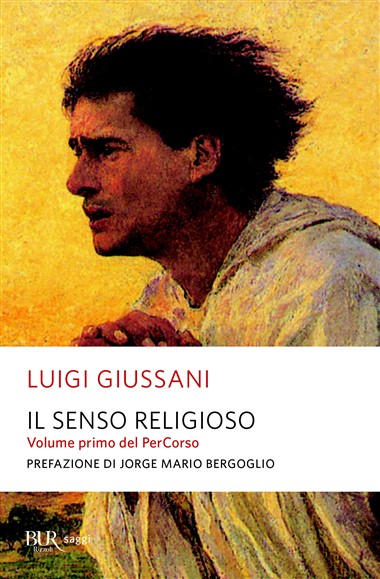
Giussani, Luigi. Il senso religioso: Volume primo del PerCorso. Prefazione di Jorge Mario Bergoglio. Saggi. Milano: BUR Rizzoli, 2023.
Nuova edizione dell’opera Il senso religioso: Volume primo del PerCorso pubblicata da BUR nella collana “Saggi”. Il testo di Giussani non ha subito modifiche rispetto al volume uscito per i tipi di Rizzoli nel 2010. Nella presente ristampa BUR (nel colophon: giugno 2023, venticinquesima edizione) sono state aggiornate le note e corretti i refusi riscontrati sia in Rizzoli, 2010 sia nella prima stampa dell’edizione BUR (nel colophon: marzo 2023, ventiduesima edizione).
Il testo si apre con una nuova prefazione intitolata Per l’uomo (pp. V-XI); si tratta dell’intervento di Jorge Mario Bergoglio, allora arcivescovo di Buenos Aires, pronunciato in occasione della presentazione pubblica dell’edizione spagnola per la diffusione in Sudamerica di Il senso religioso (El sentito religioso, Ediciones Encuentro; Editorial Sudamericana, 1998). L’incontro ebbe luogo a Buenos Aires il 16 ottobre 1998. Nel 1999, il testo di Bergoglio è pubblicato in lingua italiana in Litterae Communionis-Tracce con il titolo “La gratitudine di Buenos Aires” (4 1999: pp. 14-16).
Segue l’“Introduzione” dell’Autore (p. XIII). Espunta invece la Prefazione di James Francis Stafford (redatta per l’edizione Rizzoli, 1997 e presente anche in Rizzoli, 2010).
L’Autore si è occupato per la prima volta di questo tema nel dicembre 1957 con un volumetto (Il senso religioso, GIAC) rivolto ai soci adulti della Gioventù di Azione Cattolica milanese, il cui argomento è in parte dettato dalla lettera pastorale dell’arcivescovo Montini per la Quaresima 1957 intitolata Sul senso religioso (lo scritto di Giussani e la lettera di Montini sono ripubblicati integralmente in Montini, Giovanni Battista, e Giussani, Luigi. Sul senso religioso. BUR, 2009, pp. 45-127).
Nel 1966, Jaca Book edita per la prima volta il volume Il senso religioso che raccoglie organicamente appunti, rivisti dall’Autore, di lezioni tenute al liceo milanese Berchet fra il 1954 e il 1960 circa (collana “Note e sintesi”); lo scritto ottiene l’imprimatur ecclesiastico (Venegoni 16 III 1966 / Nihl obstat quominus imprimatur /sac. Carolus Figini cens. Eccl.).
Nel testo sono riportate e approfondite le tematiche trattate dall’Autore nel 1957. L’edizione 1966 è ora pubblicata in Il senso di Dio e l’uomo moderno: La “questione umana” e la novità del Cristianesimo (BUR Rizzoli, 2010, pp. 7-75. Prima edizione: BUR, 1994).
Nel 1975, Jaca Book ristampa il volume del 1966 nella collana “Richieste 1” senza apportare variazioni al testo (ristampa conforme all’originale, modificati formato e copertina).
Nel 1977, il testo è rieditato senza variazioni nella collana della Jaca Book “Già e non ancora”. La “Nota di edizione” (pp. 7-10) anticipa però un nuovo progetto editoriale: gli argomenti trattati verranno infatti sviluppati nei volumi del perCorso (Il senso religioso: Volume primo del perCorso, 1986; All’origine della pretesa cristiana: Volume secondo del perCorso, 1988; Perché la Chiesa: Tomo 1: La pretesa permane: Volume terzo del perCorso, 1990; Perché la Chiesa: Tomo 2: Il segno efficace del divino nella storia: Volume terzo del perCorso, 1992).
Nel 1986, esce Il senso religioso: Volume primo del perCorso (Jaca Book).
Nel febbraio 1988 il volume ottiene l’imprimatur ecclesiastico (in Curia Arch. Mediolani, die 15 febbraio 1988, Giovanni Saldarini pro Vic. Gen.); con l’occasione esce la seconda edizione dello scritto (Jaca Book), senza variazioni.
Nel 1994, esce Opere: 1966-1992, una miscellanea in due volumi che raccoglie tutti gli scritti di Giussani pubblicati da Jaca Book. Il primo volume ripropone Il PerCorso (pp. 1-618) e, in appendice, Il senso religioso nell’edizione 1977 (è infatti inclusa la “Nota di edizione” che non era presente nell’edizione 1966; pp. 619-682).
Nel 1995, Il senso religioso, esaurito nell’edizione Jaca Book del 1986, è ripubblicato da Cooperativa Editoriale Nuovo Mondo.
Nel 1997 Rizzoli inizia la ripubblicazione del PerCorso in veste definitiva, che si concluderà nel 2003.
Nel primo volume, Il senso religioso, rispetto all’edizione precedente sono state aggiunte le note a piè di pagina e corretti i refusi.
Dal 2003 il primo volume del PerCorso è disponibile anche in edizione economica (BUR; nel 2010 pubblicato anche in formato pdf e ePub).
Nel 2007, per iniziativa editoriale di Rizzoli, l’opera è pubblicata nel volume L’itinerario della fede che ripropone integralmente il PerCorso (“Il senso religioso [1997]”, in Rizzoli, 2007, pp. 7-190).
Nel 2010, escono la nuova edizione Rizzoli del volume (Il senso religioso: Volume primo del PerCorso, Rizzoli, 2010) e il relativo audiobook, corredato di un fascicolo che, come è detto nella Nota introduttiva (pp. 5-6), ripropone due capitoli fondamentali dell’opera: “Capitolo quinto. Il senso religioso: sua natura” e “Capitolo decimo. Come si destano le domande ultime. Itinerario del senso religioso”.
Per iniziativa editoriale di RCS: Corriere della Sera, il 20 febbraio 2016 Il senso religioso esce in abbinamento al quotidiano nella collana “I manuali del Corriere della Sera”. Si tratta del primo di dieci volumi dell’Autore che saranno in edicola settimanalmente. Il volume è corredato di una Presentazione inedita redatta da Antonio Polito. Il testo di Giussani è una ristampa conforme all’originale dell’edizione Rizzoli, 2010.
Il senso religioso (Rizzoli, 1997) è inoltre stato oggetto di riflessione in conversazioni fra l’Autore e alcuni membri dell’associazione Memores Domini (Quasi Tischreden) raccolte principalmente in L’autocoscienza del cosmo (BUR, 2000, T188-191, T196-197, T200), ma anche in altri volumi della medesima collana: «Tu» (o dell’amicizia) (BUR, 1997, T202), L’attrattiva Gesù (BUR, 1999, T195; nuova edizione BUR Rizzoli, 2025) e Dal temperamento un metodo (BUR, 2002, T198). [P. M.]
The “religious sense” is that set of questions that constitute the fabric of reason and the impetus of affectivity, “Why, in the end, is life worth living? What is the ultimate sense of the reality around me—nature, things, people, encounters, events?”
The book opens with a threefold methodological premise—to get to know ourselves and reality we need realism, that is, the awareness that the method of any research does not originate from a preconceived scheme but is imposed by the object. Secondly, we need to be faithful to our nature, our reasonableness, that is, a capacity to seize and affirm reality in the totality of factors. Finally, we need morality, a willingness to love the truth more than we love our own images and thoughts.
How do we proceed, then, if the religious sense is the object of knowledge? By paying attention to ourselves, to our own “I-in-action” and by continually comparing ourselves with the “elementary experience,” that complex of needs and evidences that constitute the original structure of man, however differently conceived and translated in history and cultures. We will then realize that alongside the “carnal” reality there is a “spiritual” one, consisting of ineradicable questions, “What is the ultimate meaning of life? Why is there pain and death, and why, in the end, is life worth living? What does reality consist of and what is it made for?” The more we are implicated in an attempt to address such questions, the more we find ourselves incapable of a comprehensive answer. Then again, not to admit the existence of an answer would be to suppress the question itself: only the affirmation of the Mystery as an existing reality—the hypothesis of God—corresponds to our structure, safeguards the nature of reason.
Before the ultimate questions about the meaning of ourselves and the world, we are continually tempted to assume unreasonable positions; and thus we empty the questions which, time after time, are regarded as meaningless, reduced to an effort of will or forgotten, or we diminish their content to an aesthetic and sentimental evasion, to a desperate negation of the possibility of answering these questions or to a hope in the future evolution of the social order. This leads to fatal consequences—the sense of the past is blurred, the fecundity of the future is dried up, and dialogue and communication are reduced; above all, freedom is lost, that is to say the capacity to be fulfilled, to reach and face one’s destiny. Indeed, human beings can only be truly free if they admit the existence of something inside themselves that is not derived from their own biological and historical antecedents, but which is a direct relationship with the infinite. So here is the paradox—freedom is dependence upon God.
The religious sense continuously reemerges in the impact with reality. By being attentive to our own experience, we first feel awe at a reality that imposes itself and that we did not ourselves make; within this reality we perceive an order (cosmos) and a plan which can be providential, favorable to us. Only later, as we become aware of our own “I,” do we realize that we do not give life to ourselves, that we are dependent upon another, upon a faceless “you” whom religious tradition calls “God.” This is why prayer—the awareness of Another as our very substance—is the only gesture that is fully human.
Facing the nature and needs of the “I” that refer to something else, to a “beyond,” we must affirm that the answer is there even if we do not see it or understand it. This is reason’s greatest discovery—the existence of something infinite, incommensurate, to which all human movement is destined. Thus, Mystery is no longer understood as a mere limit of reason, but as a sign of its infinite openness.
Human freedom is therefore continually involved in the adventure of interpreting a reality that manifests itself as a sign. It is primarily about what position to take in the face of everything—either a sincere and wide-open gaze, full of expectation, or an attempt to defend oneself and to admit only what one considers consonant with oneself. To maintain this positive attitude, to respond to the being that comes to it, freedom continually needs education; for if one begins with a negative hypothesis, even if there is something there to find, it will never be found.
All those who take their humanity seriously will thus find themselves in a dizzying position, yearning to penetrate the Mystery whose face they cannot see—in this dramatic threshold we will always be tempted to eliminate this vertigo by identifying the total meaning with something comprehensible. This is the existential root of “original sin”—the human being becomes the measure of all things.
But, at the edge of this passionate and hard-won awareness of existence, a cry of the truest humanity breaks out as an entreaty, a begging, asking for meaning to be revealed and made known—it is the great hypothesis of revelation. In a broad sense, revelation is the disclosure of God through the sign of the world; in a proper sense it means a possibly real fact, an historical event, with which, as in the case of Christianity, the Mystery identifies itself. The hypothesis of revelation, in no way befitting the supreme category of reason (the category of possibility), cannot be destroyed by any preconception or option because it raises a factual issue to which the nature of the heart is originally open. “To deny that this hypothesis is possible,” the Author notes, “is the ultimate and extreme form of idolatry.” This openness—the religious sense—must prevail if life is to be realized. This is the frontier of human dignity.
