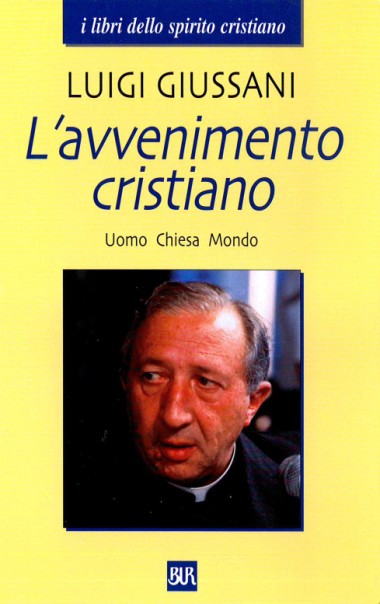
Giussani, Luigi. L’avvenimento cristiano: Uomo Chiesa Mondo. I libri dello spirito cristiano. Milano: Biblioteca Universale Rizzoli, 2003.

L'avvenimento cristiano: Uomo Chiesa Mondo
Giussani Luigi  Author

BUR Italian 2003 Pages: 160

Latest update
26/02/2026


Giussani, Luigi. L’avvenimento cristiano: Uomo Chiesa Mondo. I libri dello spirito cristiano. Milano: Biblioteca Universale Rizzoli, 2003.


Full Text

Editorial History

Nel 2003 Rizzoli ripubblica integralmente il volume miscellaneo L’avvenimento cristiano: Uomo Chiesa Mondo (1993, BUR “Supersaggi”) nella collana BUR “I libri dello spirito cristiano”. In tale occasione il testo è rivisto e vengono aggiunti l’apparato note (pp. 131-139), le fonti bibliografiche (pp. 141-144) e gli indici tematici (pp. 145-155).

Il volume è diviso in tre sezioni.

La “Parte prima. La libertà dell’uomo e l’avvenimento cristiano” comprende gli scritti “Il cristianesimo: incontro umano” (2003, pp. 7-25), testo inedito dell’intervento dell’Autore alla Giornata d’inizio anno degli universitari (Milano, 27 ottobre 1992), e “Dal Battesimo una creatura nuova” (pp. 23-25), intervento al Sinodo dei Vescovi sui laici (Roma, 9 ottobre 1987), uscito integralmente sull’agenzia di stampa ADISTA con il titolo “Mons. Giussani: Comunione vivente col Papa, luogo dell’ultima pace per ogni fedele” (22-24 ottobre 1987) e, successivamente, con il titolo “Obbedienza è carisma dei movimenti”, in Il Regno Documenti (21, 1987: pp. 665-666).
La sintesi dell’intervento è stata pubblicata in L’Osservatore Romano (11 ottobre 1987) e in CL-Litterae Communionis con il titolo “I movimenti ecclesiali forme storiche per la missione della Chiesa” (11, 1987: p. 5. Con successive traduzioni).
Nel 1997, a dieci anni dal Sinodo, Litterae Communionis-Tracce ha riproposto il testo nella versione più ampia pubblicata da ADISTA, unitamente all’omelia e al discorso di Giovanni Paolo II ai Padri Sinodali del 30 ottobre 1987 (“Dal Battesimo un protagonista nuovo” in Litterae Communionis-Tracce, 9, 1997: p. 51). Nel 2005, l’intervento dell’Autore è pubblicato con il titolo “Dal battesimo una creatura nuova” nel numero di Litterae Communionis-Tracce interamente dedicato a Giussani dopo la sua morte (“Don Luigi Giussani, 15 ottobre 1922 - 22 febbraio 2005”, 3, 2005: p. 86).

La “Parte seconda”, intitolata “La Chiesa, corpo vivo di Cristo”, raggruppa i seguenti interventi:

- “Come nasce un movimento” (pp. 29-50), intervento di Giussani alle vacanze internazionali di CL (Corvara, agosto 1989), già pubblicato con lo stesso titolo nel mensile 30 Giorni (2, 1990: pp. 4-13. Con successive traduzioni), nella miscellanea Un avvenimento di vita, cioè una storia: Itinerario di quindici anni concepiti e vissuti: Interviste, conversazioni, interventi di monsignor Luigi Giussani a partire da registrazioni, non rivisti dall’autore (a cura di Carmine Di Martino. EDIT: Il Sabato, 1993, pp. 394-412) e nel volume Comunione e Liberazione: Un movimento nella Chiesa (a cura di Davide Rondoni. Cooperativa Editoriale Nuovo Mondo, 1998, pp. 71-85. Con successive traduzioni). Nel 2022, in occasione del Centenario della nascita dell’Autore, la parte corrispondente al paragrafo “«E il Verbo si è fatto carne»” (pp. 30-33) è stata ripubblicata con il titolo “Il bel giorno” in Litterae Communionis-Tracce (9, 2022: pp. 11-13. Con successive traduzioni); 

- “Memoria, non devoto ricordo” (pp. 51-57), testo di una meditazione per il Giovedì Santo tenuta da Giussani agli universitari (Certosa di Pavia, 8 aprile 1993), già pubblicata con lo stesso titolo in CL-Litterae Communionis (5, 1993: inserto. Con successive traduzioni);

- “L’avvenimento implica un metodo” (pp. 59-63), testo dell’intervento all’Assemblea responsabili di CL (Milano, 24 novembre 1992; nelle “Fonti” l’evento è erroneamente datato 10 ottobre 1992; BUR, 2003, p. 142), già pubblicato su CL-Litterae Communionis (1, 1993, inserto. Con successive traduzioni) con il titolo “L’avvenimento è un metodo” (nel testo BUR è stato espunto il cappello introduttivo);

- “Il sacrificio più grande è dare la propria vita per l’opera di un Altro” (pp. 65-70), testo dell’intervento dell’Autore al Consiglio nazionale dei responsabili di CL (Milano, 15 febbraio 1992), pubblicato con lo stesso titolo in CL-Litterae Communionis (4, 1992: inserto), nel libretto Dalla fede il metodo: Conversazioni di Luigi Giussani: 1992-1994 (Cooperativa Editoriale Nuovo Mondo, 1994, pp. 25-28), in forma parziale nel numero di Litterae Communionis-Tracce interamente dedicato a Giussani dopo la sua morte (“Don Luigi Giussani, 15 ottobre 1922 - 22 febbraio 2005”, 3, 2005: pp. 78-79) e, integralmente, in Litterae Communionis-Tracce (4, 2005: pp. 1-7);

- “L’appartenenza sorgente di moralità e di cultura” (pp. 71-77), sintesi dell’intervento di Giussani alla Giornata di fine anno degli adulti di CL (Milano, 30 maggio 1992), testo pubblicato con lo stesso titolo in CL-Litterae Communionis (7/8, 1992, inserto. Con successive traduzioni). Una versione più ampia e dettagliata dello stesso intervento era stata pubblicata nel giugno dello stesso anno con il titolo Appartenere a Cristo oggi. Appunti di un approccio al problema presi in una conversazione con don Luigi Giussani: Milano, 30 maggio 1992 (supplemento a Il Sabato, giugno 27, 1992, pp. 12-31).

La terza e ultima parte è intitolata “La fede e le opere”. Fatta eccezione per il primo scritto, in essa sono proposti alcuni interventi dell’Autore alle assemblee nazionali della Compagnia delle Opere (CdO):

- “La carità costruisce per sempre” (pp. 81-86) è il testo dell’intervento dell’Autore al convegno “Nella carità la solidarietà diventa opera” (Tarcento, 25 ottobre 1986), svoltosi in occasione del decennale del terremoto in Friuli. Si segnala che in “Appendice” (p. 142) lo scritto viene erroneamente definito come esito di una conversazione con alcuni adulti del Friuli; si tratta invece del suo contributo al convegno (dato reperito presso l’Archivio della Fraternità di Comunione e Liberazione). Lo scritto è stato pubblicato con lo stesso titolo in CL-Litterae Communionis (2, 1987: pp. 22-24. Con successive traduzioni) e successivamente è stato rieditato come “La carità si fa opera” in Il lavoro dell’uomo: Interventi di monsignor Luigi Giussani (EDIT, 1988, pp. 17-21. Con successive traduzioni) e nella miscellanea L’io, il potere, le opere: Contributi da un’esperienza col titolo “Di fronte al bisogno” (Marietti, 2000, pp. 124-129. Con successive traduzioni). Nel settembre 2022, successivamente alla morte di don Antonio Villa, il testo è riproposto con il titolo “La carità costruisce per sempre” sul sito web di Comunione e Liberazione (https://it.clonline.org/news/attualit%C3%A0/2022/09/14/morte-Antonio-Villa-Don-Giussani-1986+.Verificato in data 10/06/2024. Con successiva traduzione);

- “Vivere con gioia la terra del Mistero” (pp. 87-91) è la sintesi di un intervento dell’Autore alla prima Assemblea nazionale della CdO (Milano, 5 dicembre 1987), pubblicata, con lo stesso titolo e senza variazioni, in Il lavoro dell’uomo (EDIT, 1988, pp. 23-26. Con successive traduzioni), in Le opere: “La fede senza le opere è morta” (Cooperativa Editoriale Nuovo Mondo, 1989, pp. 18-19, “Grandi Quaderni di Litterae Communionis 4”), in Corriere delle Opere (7, 1991: p. 8-9) e nella miscellanea L’io, il potere, le opere: Contributi da un’esperienza con il titolo “Dal cuore il lavoro, dal lavoro l’opera” (Marietti, 2000, pp. 91-95);

- “Le opere: realismo e creatività della fede” (pp. 93-101; CdO, Milano, 4 marzo 1989) è stato pubblicato con lo stesso titolo in CL-Litterae Communionis (4, 1989: pp. 8-11. Con successive traduzioni), riproposto identico nel fascicolo intitolato Le opere: “La fede senza le opere è morta” (Cooperativa Editoriale Nuovo Mondo, 1989, pp. 20-23, “Grandi Quaderni di Litterae Communionis 4”), in Corriere delle Opere (7, 1991: pp. 10-12) e nel volume L’io, il potere, le opere: Contributi da un’esperienza (secondo paragrafo del capitolo “La compagnia si dilata in libertà”, Marietti, 2000, pp. 154-161);

- “Veramente utili alla compagnia umana” (pp. 103-110; CdO, Milano, 26 gennaio 1991) è stato pubblicato con il titolo “La felicità e le opere” in Corriere delle Opere (3, 1991: pp. II-IV), con il titolo “Perché tu sia felice” in CL-Litterae Communionis (3, 1991: inserto. Con successive traduzioni), con il titolo “Veramente utili alla compagnia umana” in Corriere delle Opere (7, 1991: pp. 13-15) e nella miscellanea L’io, il potere, le opere: Contributi da un’esperienza (primo paragrafo del capitolo “La compagnia si dilata in libertà”, Marietti, 2000, pp. 148-154).
“Le opere nascono solo quando uno ha il coraggio di dire «io»” (pp. 111-115; CdO, Milano, 14 marzo 1992) è stato pubblicato con lo stesso titolo nel fascicolo Intanto qualcuno costruisce (atti del convegno, supplemento al Corriere delle Opere, 3, 1992: pp. 5-8), in CL-Litterae Communionis (5, 1992: inserto) e in L’io, il potere, le opere: Contributi da un’esperienza (Marietti, 2000, p. 99-102).

- “Una passione per l’uomo” (pp. 117-121; CdO, Milano, 6 febbraio 1993) è stato pubblicato con lo stesso titolo nel fascicolo Una tensione ideale (atti del convegno, supplemento a Corriere delle Opere, 4, 1993: pp. 7-10) e in L’io, il potere, le opere: Contributi da un’esperienza (Marietti, 2000, pp. 129-133. Con successive traduzioni) con il titolo “Creare una casa più abitabile per l’uomo”.

In “Appendice” è riportata l’intervista all’Autore dal titolo “Don Giussani: il potere egoista odia il popolo” (pp. 125-130), a cura di Gianluigi Da Rold, a conclusione del pellegrinaggio a Lourdes per il decennale del riconoscimento pontificio della Fraternità di CL (17 ottobre 1992) e pubblicata sul Corriere della Sera il 18 ottobre 1992 (p. 3). Il testo è stato rieditato in CL-Litterae Communionis (11, 1992: pp. 60-63. Con successive traduzioni) con il titolo “Un problema di metodo” e, nel 2000, è stato posto in appendice alla miscellanea L’io, il potere, le opere: Contributi da un’esperienza (Marietti, 2000, pp. 214-219. Con successive traduzioni) con il titolo “Il potere egoista odia il popolo”. [P. M.]

Summary of contents

Part One—Human Freedom and the Christian Event

Christianity—a Human Encounter
Our age is one in which, although vaguely and confusedly “religious” attitudes have become fashionable again, God seems to have nothing more to do with life. However, by eliminating the Mystery as a fact of reality, man is defined only by his biological antecedents—a subject, thus, at the mercy of power. Instead, he is a direct relationship with God—the conscious affirmation of this truth entails certain consequences. First, the possibility of certainty and the consequent ability to construct; then, the intuition and imagination of an ideal from which every human impetus starts. In addition to this, the awareness of one’s own evil, which man is always tempted to flee, finding his own error intolerable. Mankind does not know the face of Destiny.  This possibility, so desired by one’s heart, would be realized only in the event that God Himself took the initiative by becoming an event in life—this really happened in Christ. In the encounter with such an event, a total correspondence to the deepest needs of our human reason and heart occurs. Running into this Presence creates, then, an unparalleled companionship, a people; and by belonging to this people a moral phenomenon springs forth and takes root, as a continuous tension to the good—one no longer lives for oneself, but so that the design of Another may be accomplished.

From Baptism, a New Creature
Man today has very great difficulty perceiving Christ as the clear and certain response to his own life. Often institutions do not offer this response. It is not so much that verbal or cultural repetition of the Christian annunciation is missing, but the experience of an encounter. In this way, the Mystery of the Church must always be a presence that moves, that is, movement. Every realization of Baptism is a gift of the Spirit incarnated in the temperament and history of each person. This gift of the Spirit can communicate itself with a particularly persuasive force so as to spark a stable dynamic of communion, living which is an aspect of obedience to the great mystery of the Spirit. Thus arose the ecclesial movements. These are historical forms with which the Spirit helps the Church’s own mission today.

Part Two—The Church, the Living Body of Christ

How a Movement Is Born
A movement is born out of a living testimony. Christ is the center of our whole life. This truth appeared on the horizon of Fr. Giussani’s experience “through the grace of God, like a beautiful day” (Camus) when his high-school teacher read and explained the first page of the Gospel of Saint John, “The Word of God was made flesh. Therefore Beauty, Goodness, Justice, Truth were made flesh.” 
But if God became man, if He is here and communicates Himself to us, we are “one.” Christ is present precisely through the unity of those He chooses. If we acknowledge Him, He acts, and our life becomes more human. The community becomes the place of memory—the consciousness of a Presence that began in the past and lasts in the present; some aspects of this reality of the community can be described. Above all, it does not suppress the drama of the single person in adhering to the proposal that has been made to him or her. By living this drama one can understand that entreaty, prayer, is the supreme gesture of human nature; the sacrament is the greatest prayer, as the entreaty of one’s whole self. 
The object of our entreaty is affection for Christ, the only One who is able to sustain life because He is capable of encompassing all of it, who generates that gladness capable of embracing sacrifice and makes one discover the importance of the instant as the meeting point between what is ephemeral and the Mystery. One cannot adhere to Christ if one does not perceive that He is true today. The community, where the encounter with Christ takes place again, is the place to which our “I” belongs—the law of life becomes, then, obedience to the Church.

Memory, not a Devout Remembrance
“The encounter with Jesus Christ is a contemporary event,” this is the essence of the charism of Communion and Liberation. In our Christian vocabulary, the word “memory” brings to mind a moment in the past, but one that becomes greater and greater over time. With two conditions. First of all, the encounter coincides with precise circumstances, “the faith is a heartfelt obedience to that form of teaching to which we have been entrusted” (Ratzinger). Second, the way to certainty about Christ is defined by the curiosity aroused by the encounter.

The Event Implies a Method
The word “event” indicates the method chosen by God to save man—a human companionship in which His presence is made experienceable. However, this is the most difficult word to be understood and accepted by modern mentality, as it indicates a coincidence between the experienceable reality and the supernatural. Since the event coincides with a method, our response to it is an obedience to the manner in which it was and is posed, that is, it is an obedience to the charism.

The Greatest Sacrifice Is to Give Your Life for the Work of Another
The real protagonist in history is the unity of a people whose ontological value finds its root in the presence of Christ. From here, a moral value also emerges—unity is the fruit of our freedom, as acknowledgment and consent. The most indicative moral formula for the praxis of Christian living is that the greatest sacrifice is to give your life for the work of Another. This Other (that is Christ in His Church) always involves referring to something historical and concrete. The essence of our charism can be summed up in three factors—the announcement that God has become man (the astonishment and enthusiasm for this); affirming that this man is present in a sign of “concord,” of a people in unity; and also, that only in His presence can man truly be man. 
In identifying with each one’s responsibility, the charism takes up diverse inflections according to each one’s generosity. The comparison with the charism, just as it emerged at the origins of our common history, must be our greatest concern, and it is accomplished in two ways—first, the comparison with the person with whom everything began; then the texts left behind, and the succession of the people indicated as the reference point. To speak of a charism without historicity is not to speak of a Catholic charism.

Belonging as Source of Morality and Culture
Recognizing being joined together because Christ is there develops the sense of belonging that constitutes the person himself. Christ’s companionship to life is called “Church” in its ultimate completeness. But its value as Church is concretized to the point of becoming the value and truth of the movement. The demonstration that Christ is present in the companionship lies in this: it is made up of people who, if they remain faithful, eventually change. Experiencing this belonging means that the law of life is obedience to the Mystery that is present in the companionship. A true conception of the moral problem arises from the companionship, and inside it the cultural problem is also resolved.

Part Three—Faith and Works

The Charity that Creates Works that Will Never End
In the face of need, every man of good will moves into action, but if he is true to himself, he feels his action is powerless in the face of evil. “Culture” and “charity” are the two words suggesting the way for solidarity to become a clear contribution to the reconstruction of a people. Culture is the connection between the particular and a wider horizon, and so the gesture of solidarity of a single person is connected to something greater. Charity adds to solidarity an awareness of the imitation of the Mystery of Being that is Law for man. Only this way does man truly become “creator”—that is, “subject,” implementor of works.

Living the Mystery with Joy
The Mystery that created all things has an expressive dynamic rooted within the reality of Trinity, but which reverberates outside of itself through creation. This is also true for us—work is an expression of our being. But our very being is a thirst for happiness; therefore, there is no work that can escape the search for complete satisfaction, for human fulfillment. We refer to this desire for fulfillment as the “religious sense.” Thus, work must assist and be in function of the truth and happiness to which man aspires. Christ has established in history the belonging to a reality where the supreme concern is for destiny—the Church.

Works—Realism and Creativity of Faith
The Christian event generates realism and a true capacity to answer everyone’s need. Works, that is the attempt to give answer to those needs that make up human existence, define man as he tries to imitate God and he continues the figure of Christ in history. The Christian experience makes us extremely sensitive to the other’s need. Above all, it is not an agency for projects, but a proof that a change can actually happen—inside ordinary daily work, there can be a new dimension of gratuitousness. Therefore, the first goal of this companionship is to promote the birth of social works that answer the serious need of society. However, we become capable of creating this kind of works only if we are loyal, intense and generous in our daily work. In order to have this proper Christian sensitivity, we must beg every morning for wisdom from God. 

To Be Truly Useful to the Human Companionship
Happiness is the word that describes the whole movement of human action. The Lord calls man to life so that he may be happy. There is a law for all this to happen—we need to learn to embrace those conditions we do not define ourselves, and this involves an effort. However, we must not fear this law because, from the moment God became one of us taking on our human condition, strain began to bear a name that defines it in all its reasonableness—cross. Creativity makes us participate in the gesture by which God drew everything out of nothingness toward a destiny that took on a name in history, Christ.

Works Come About Only When a Person Has the Courage to Say “I”
Just as values remain abstract when there is no one who has the courage to say “I,” even works come about only when a person has the courage to say “I.” This is how works come about. But just as you cannot be born alone and you cannot live alone, you cannot respond to your own need. Work becomes the ultimate synthesis of the relationship between the “I” and the reality that stimulates it, urging it on towards destiny, that is towards Christ; and the synthesis between this urging of reality and the relationship with all those who acknowledge the presence of the Lord. This synthesis of the human and divine is called prayer; therefore, work is real prayer, and there is no prayer if it is not work.

A Passion for the Person
Friendship is a companionship guided towards Destiny. For people, Destiny is a friend—Christ. The Christian companionship must be directed to “creating a more habitable dwelling” for the human person, because the passion of a Christian is focused on humanity in its manifest concreteness. Those who encountered Christ were fascinated by this—a passion for the person. It is this charity of Christ that we must imitate; it is the factor that challenges and penetrates all other factors of human experience and generates a people that could not arise otherwise. The extreme convenience of life is gratuitousness as it penetrates “within our calculations.”

Translations

Related publications

1987 - I movimenti ecclesiali: forme storiche per la missione della Chiesa - Giussani - CL-Litterae Communionis - Italian
1987 - I movimenti ecclesiali: forme storiche per la missione della Chiesa - Giussani - L'Osservatore Romano - Italian
1987 - La carità costruisce per sempre - Giussani - CL-Litterae Communionis - Italian
1987 - Mons. Giussani: Comunione vivente col Papa, luogo dell'ultima pace per ogni fedele - Giussani - ADISTA - Italian
1987 - Obbedienza è carisma dei movimenti - Giussani - Il Regno Documenti - Italian
1988 - Il lavoro dell'uomo: Interventi di monsignor Luigi Giussani - Giussani - EDIT Editoriale Italiana - Italian
1989 - "Le opere: Realismo e creatività della fede." In Le Opere: "La fede senza le opere è morta" - Giussani - Cooperativa Editoriale Nuovo Mondo - Italian
1989 - "Vivere con gioia la terra del Mistero." In Le opere: “La fede senza le opere è morta” - Giussani - Cooperativa Editoriale Nuovo Mondo - Italian
1989 - Le opere: Realismo e creatività della fede - Giussani - CL-Litterae Communionis - Italian
1990 - Come nasce un movimento - Giussani - 30 Giorni - Italian
1991 - La felicità e le opere - Giussani - Corriere delle Opere - Italian
1991 - Le opere. Realismo e creatività della fede - Giussani - Corriere delle Opere - Italian
1991 - Perché tu sia felice - Giussani - CL-Litterae Communionis - Italian
1991 - Veramente utili alla compagnia umana - Giussani - Corriere delle Opere - Italian
1991 - Vivere con gioia la terra del Mistero - Giussani - Corriere delle Opere - Italian
1992 - "Le opere nascono solo quando uno ha il coraggio di dire io." In Intanto qualcuno costruisce: Atti dell'Assemblea Nazionale: Milano 14 marzo 1992 - Giussani - Corriere delle Opere - Italian
1992 - Appartenere a Cristo oggi: Appunti di un approccio al problema presi in una conversazione con don Luigi Giussani: Milano, 30 maggio 1992 - Giussani - Il Sabato - Italian
1992 - Don Giussani: il potere egoista odia il popolo - Giussani, Da Rold - Corriere della Sera - Italian
1992 - Il sacrificio più grande è dare la propria vita per l'opera di un Altro - Giussani - CL-Litterae Communionis - Italian
1992 - L'appartenenza sorgente di moralità e di cultura - Giussani - CL-Litterae Communionis - Italian
1992 - Le opere nascono solo quando uno ha il coraggio di dire: io - Giussani - CL-Litterae Communionis - Italian
1992 - Un problema di metodo - Giussani, Da Rold - CL-Litterae Communionis - Italian
1993 - "Una passione per l'uomo." In Una tensione ideale: Assemblea Nazionale Compagnia delle Opere: Milano 6 febbraio 1993 - Giussani - Corriere delle Opere - Italian
1993 - L'avvenimento cristiano: Uomo Chiesa Mondo - Giussani - BUR - Italian
1993 - L'avvenimento è un metodo - Giussani - CL-Litterae Communionis - Italian
1993 - Memoria, non devoto ricordo - Giussani - CL-Litterae Communionis - Italian
1993 - Un avvenimento di vita, cioè una storia: Itinerario di quindici anni concepiti e vissuti: Interviste, conversazioni, interventi di monsignor Luigi Giussani a partire da registrazioni, non rivisti dall’autore - Giussani, Ratzinger, Di Martino - EDIT Editoriale Italiana: Il Sabato - Italian
1994 - Dalla fede il metodo: Conversazioni di Luigi Giussani: 1992-1994 - Giussani - Cooperativa Editoriale Nuovo Mondo - Italian
1997 - Dal Battesimo un protagonista nuovo - Giussani - Litterae Communionis-Tracce - Italian
1998 - "Come nasce un movimento." In Comunione e Liberazione: Un movimento nella chiesa - Giussani, Rondoni - Cooperativa Editoriale Nuovo Mondo - Italian
2000 - L'io, il potere, le opere: Contributi da un'esperienza - Giussani - Marietti 1820 - Italian
2005 - Don Luigi Giussani, 15 ottobre 1922 - 22 febbraio 2005 - Giussani, Ratzinger, Carrón, Giovanni Paolo II, Martini, Tettamanzi - Litterae Communionis-Tracce - Italian
2005 - Il sacrificio più grande è dare la propria vita per l'opera di un Altro - Giussani - Litterae Communionis-Tracce - Italian
2022 - Il bel giorno - Giussani - Litterae Communionis-Tracce - Italian

Translations of Related Publications

French - Genèse d'un mouvement - Giussani - 30 Jours - 1990
French - Pour que tu sois heureux - Giussani - CL-Communion et Liberation - 1991
French - Le sacrifice le plus grand est de donner sa vie pour l’œuvre d'un Autre - Giussani - CL-Litterae Communionis - 1992
French - Les œuvres naissent seulement quand quelqu'un a le courage de dire: moi - Giussani - CL-Litterae Communionis - 1992
French - L'événement est méthode - Giussani - Litterae Communionis-CL - 1993
French - "Comment naît un mouvement." Dans Communion et Libération: Un mouvement dans l’Eglise - Giussani - Cooperativa Editoriale Nuovo Mondo - 1999
French - Sens religieux, oeuvres, politique - Giussani - Litterae Communionis-Traces - 2001
French - Don Luigi Giussani, 15 octobre 1922 - 22 fèvrier 2005 - Giussani, Ratzinger, Carrón, Giovanni Paolo II, Martini, Tettamanzi - Litterae Communionis-Traces - 2005
French - Le sacrifice le plus grand est de donner sa vie pour l'œuvre d'un Autre - Giussani - Litterae Communionis-Traces - 2005
English - Human Work: Speeches by Msgr. Luigi Giussani - Giussani - Communion & Liberation -
English - [Intervention during the Synod] - Giussani - CL - 1988
English - Live with Joy the Land of the Mistery - Giussani - Cowa Publications/Litterae Communionis-CCL - 1988
English - How a Movement Is Born - Giussani - 30 Days - 1990
English - Works, Realism and Creativity - Giussani - CL-Communion & Liberation Magazine - 1990
English - Happiness and Work - Giussani - CL - 1991
English - Happiness and Works - Giussani - Cowa Publications/Litterae Communionis-CCL - 1991
English - The Greatest Sacrifice Is to Give One's Life for the Work of Another - Giussani - Human Adventure Corporation/CL-Communion & Liberation Magazine - 1992
English - The Greatest Sacrifice is to Give Your Life for Another's Work - Giussani - Cowa Publications/Litterae Communionis-CCL - 1992
English - "How a Movement is Born." In Communion and Liberation: A Movement in the Church - Giussani - Cooperativa Editoriale Nuovo Mondo - 1999
English - "How a Movement is Born." In Communion and Liberation: A Movement in the Church - Giussani - McGill-Queen's University Press - 2000
English - Fr Luigi Giussani, October 15, 1922 - February 22, 2005 - Giussani, Ratzinger, Carrón, Giovanni Paolo II, Martini, Tettamanzi - Litterae Communionis-Traces - 2005
English - The Greatest Sacrifice is to Give Your Life for an Other's Work - Giussani - Litterae Communionis-Traces - 2005
English - The beautiful day - Giussani - Litterae Communionis-Traces - 2022
Maltese - Biex int tkun ferħan - Giussani - Kultura Gdida - 1991
Polish - Jak rodzi sie ruch - Giussani - Komunia i Wyzwolenie - 1990
Polish - Abyś był szczęśliwy - Giussani - CL-Komunia i Wyzwolenie Biuletyn - 1991
Polish - Jak rodzi sie ruch - Giussani - Cooperativa Editoriale Nuovo Mondo - 1991
Polish - Dzieła rodzą się wówczas gdy ktoś ma odwagę powiedzieć "ja" - Giussani - CL-Komunia i Wyzwolenie Biuletyn - 1992
Polish - Przynależeć do Chrystusa dzisiaj - Giussani - CL-Komunia i Wyzwolenie Biuletyn - 1992
Polish - Wydarzenie jest metodą - Giussani - CL-Komunia i Wyzwolenie Biuletyn - 1993
Polish - Ze Chrztu nowe stworzenie - Giussani - Komunia i Wyzwolenie-CL - 1997
Polish - "Jak rodzi sie ruch?." W Comunione e Liberazione: Ruch w Kosciele - Giussani - Cooperativa Editoriale Nuovo Mondo - 1998
Polish - Ksiądz Luigi Giussani, 15 października 1922 - 22 lutego 2005 - Giussani - Ślady - 2005
Polish - Piekny dzien - Giussani - Litterae Communionis-Slady - 2022
Portuguese - A pertença fonte de moralidade e cultura - Giussani - CL-Litterae Communionis Portugal - 1992
Portuguese - O maior sacrifício è dar a vida pela obra de um Outro - Giussani - CL-Litterae Communionis Portugal - 1992
Portuguese - Mémoria, não recordação devota - Giussani - Litterae Communionis-CL - 1993
Portuguese - D. Luigi Giussani, 15 de Outubro de 1922 - 22 de Fevereiro de 2005 - Giussani, Ratzinger, Carrón, Giovanni Paolo II, Martini, Tettamanzi - Litterae Communionis-Passos edição portuguesa - 2005
Portuguese - O maior sacríficio é dar a própria vida pela obra de Outro - Giussani - Litterae Communionis-Passos ediçao portuguesa - 2005
Portuguese - O eu, o poder, as obras: Contributos de uma experiência - Giussani - Lucerna - 2019
Portoghese BR - “A caridade constrói para sempre.” Em Lembretes para quem faz as obras - Giussani - Casa cultura e fé - 1987
Portoghese BR - Obras: realismo e criatividade da fé - Giussani - CL-Comunhão e Libertação - 1989
Portoghese BR - "A caridade se faz obra." In A cultura da solidariedade: Escola de doutrina social: Volume 2 - Giussani - Editora Companhia Ilimitada LTDA - 1990
Portoghese BR - Como nasce um movimento - Giussani - 30 Dias - 1990
Portoghese BR - A felicidade e as obras - Giussani - CL-Comunhão e Libertação - 1991
Portoghese BR - As obras nascem somente quando se tem a coragem de dizer eu - Giussani - CL-Litterae Communionis - 1992
Portoghese BR - O maior sacrifício é dar a própria vida pela obra de um outro - Giussani - CL-Litterae Communionis - 1992
Portoghese BR - O pertencer, fonte de moralidade e de cultura - Giussani - CL-Litterae Communionis - 1992
Portoghese BR - Um problema de método - Giussani - CL-Litterae Communionis - 1992
Portoghese BR - Memória, não devota lembrança - Giussani - Litterae Communionis-CL - 1993
Portoghese BR - O acontecimento é um método - Giussani - Litterae Communionis-CL - 1993
Portoghese BR - "Como nasce um movimento." Em Comunhão e Libertação: Um movimento na Igreja - Giussani - Sociedade Litterae Communionis - 1999
Portoghese BR - O eu, o poder, as obras: Contribuição de uma experiência - Giussani - Editora Cidade Nova - 2001
Portoghese BR - Do coraçâo, o trabalho. Do trabalho, a obra - Giussani - Litterae Communionis-Passos edição brasileira - 2003
Portoghese BR - O maior sacrifício é dar a vida pela obra de um Outro - Giussani - Litterae Communionis-Passos edição brasileira - 2005
Portoghese BR - Padre Luigi Giussani. 15 de outubro de 1922 - 22 de fevereiro de 2005 - Giussani, Ratzinger, Carrón, Giovanni Paolo II, Martini, Tettamanzi - Litterae Communionis-Passos edição brasileira - 2005
Portoghese BR - O belo dia - Giussani - Litterae Communionis-Passos edição brasileira - 2022
Romanian - Eul, puterea, operele - Giussani - Editura Nemira - 2005
Russian - "Kak rodžaetsja dviženie." V Comunione e Liberazione: Dviženie v Tserkvi - Giussani - Christianskaja Rossija -
Russian - Ja, vlast', dela: Razmyšlenija, Pocerpnutye iz opyta - Giussani - Christianskaja Rossija - Duchovnaja biblioteka - 2004
Russian - Otez Luigi Giussani 15 oktjabrja 1922 - 22 fevralja 2005 - Giussani, Ratzinger, Carrón, Giovanni Paolo II, Martini, Tettamanzi - Litterae Communionis-Sled - 2005
Russian - Samaja bol'šaja žertva - otdat' žizn' radi dela Inogo - Giussani - Litterae Communionis-Sled - 2005
Slovak - Východiskový bod: Ako sa rodí hnutie - Giussani - Cooperativa Editoriale Nuovo Mondo - 1991
Spanish - El Sentido del Trabajo: Apuntes de algunas conversaciones con Luigi Giussani - Giussani - Centro Cultural La Aventura Humana -
Spanish - El trabajo del hombre - Giussani - Centro de Solidaridad San Roque - Casa Cultura y Fe -
Spanish - El trabajo del hombre - Giussani - Comunión y Liberación -
Spanish - Don Giussani en el Sínodo - Giussani - Testimonio - 1987
Spanish - La Iglesia particular corre el riesgo de ser insuficiente - Giussani - Ecclesia - 1987
Spanish - Los movimientos eclesiales: formas históricas para la misión de la iglesia - Giussani - Nueva Tierra - 1988
Spanish - “La caridad se hace obra." En Una experiencia que se hace escuela: Curso de doctrina social de la Iglesia, de Luigi Giussani, Filippo Santoro, Rocco Buttiglione, Pedro Morandé, Marco Martini y Fernando Bastos de Avila - Giussani, Buttiglione, Santoro, Morandé, Martini, Bastos de Avila - Editorial Docencia - 1989
Spanish - “Sentido religioso y trabajo.” En Una experiencia que se hace escuela: Curso de doctrina social de la Iglesia, de Luigi Giussani, Filippo Santoro, Rocco Buttiglione, Pedro Morandé, Marco Martini y Fernando Bastos de Avila - Giussani, Buttiglione, Santoro, Morandé, Martini, Bastos de Avila - Editorial Docencia - 1989
Spanish - Las obras, realismo y creatividad de la fe - Giussani - Comunión y Liberación - 1989
Spanish - Las obras: realismo y creatividad de la fe - Giussani - Huellas - 1989
Spanish - Las obras: realismo y creatividad de la fe - Giussani - Nueva Tierra - 1989
Spanish - Como nace un movimiento - Giussani - Comunión y Liberación - 1990
Spanish - Como nace un movimiento - Giussani - Esquiú - 1990
Spanish - Para que tu seas feliz - Giussani - CL-Litterae Communionis - 1991
Spanish - Para que tú seas feliz - Giussani - Comunión y Liberación - 1991
Spanish - El mayor sacrificio es dar la propia vida por la obra de Otro - Giussani - CL-Litterae Communionis - 1992
Spanish - El sacrificio mas grande es dar la propia vida por la obra de Otro - Giussani - CL-Comunión y Liberación - 1992
Spanish - La pertenencia fuente de moralidad y de cultura - Giussani - CL-Litterae Communionis - 1992
Spanish - Las obras nacen solo cuando uno tiene el valor de decir: yo - Giussani - CL-Litterae Communionis - 1992
Spanish - Un problema de método - Giussani - CL-Litterae Communionis - 1992
Spanish - La experiencia de la fe como realidad: Una entrevista y dos conversaciones de monseñor Luigi Giussani - Giussani - El hilo rojo Universitarios Argentinos - 1993
Spanish - Del Bautismo a la ecumene católica - Giussani - Litterae Communionis-Huellas - 1997
Spanish - Las obras nacen sólo cuando uno tiene el coraje de decir: yo - Giussani - Litterae Communionis-Huellas - 1997
Spanish - "Cómo nace un movimiento." En Comunión y Liberación: Un movimiento en la Iglesia - Giussani - Ediciones Encuentro - 1999
Spanish - El yo, el poder, las obras: Contribuciones a partir de una experiencia - Giussani - Ediciones Encuentro - 2001
Spanish - Don Luigi Giussani, 15 de octubre de 1922 - 22 de febrero de 2005 - Giussani, Ratzinger, Carrón, Giovanni Paolo II, Martini, Tettamanzi - Litterae Communionis-Huellas - 2005
Spanish - El mayor sacrificio es dar la vida por la obra de Otro - Giussani - Litterae Communionis-Huellas - 2005
Spanish - El yo, el poder, las obras: Contribuciones a partir de una experiencia - Giussani - Ediciones Encuentro - 2008
Spanish - El Valor del Trabajo - Giussani - Trabajo y persona - 2010
Spanish - El yo, el poder y las obras - Giussani - Fondo Editorial UCSS - Ediciones Encuentro - 2012
Spanish - El bello día - Giussani - Litterae Communionis-Huellas - 2022
German - Die kirchlichen Bewegungen: Geschichtliche Formen für die Sendung der Kirche - Giussani - Litterae Communionis-CL - 1987
German - Wörtliche Wiederholung ungenügend - Giussani - L'Osservatore Romano - 1987
German - Wie eine Bewegung entsteht: Ansprache von Don Luigi Giussani bei den Internationalen Ferien von Comunione e Liberazione 1989 - Giussani - Cooperativa Editoriale Nuovo Mondo - 1991
German - Das größte Opfer ist die Hingabe des eigenen Lebens für das Werk eines Anderen - Giussani - CL - 1992
German - Die Zugehörigkeit, Quelle der Moralität und der Kultur - Giussani - CL - 1992
German - Werke entstehen nur, wenn jemand den Mut hat, ich zu sagen - Giussani - CL - 1992
German - Das Ereignis ist eine Methode - Giussani - CL - 1993
German - "Wie eine Bewegung entsteht." In Comunione e Liberazione: Eine Bewegung in der Kirche - Giussani - Cooperativa Editoriale Nuovo Mondo - 1999
German - Die Nächstenliebe baut auf für immer - Giussani - CL - 1999
German - Das größte Opfer ist die Hingabe des eigenen Lebens für das Werk eines Anderen - Giussani - Litterae Communionis-Spuren - 2005
German - Luigi Giussani 15. Oktober 1922 - 22. Februar 2005 - Giussani - Litterae Communionis-Spuren - 2005
Hungarian - Communio et Liberatio: A kiindulópont: Hogyan születik egy mozgalom? - Giussani - Cooperativa Editoriale Nuovo Mondo - 1991

Original Text

Names

Giussani Luigi  Author
Open in a new page


Biography
Secondary Bibliografy
Editorial Criteria
Introduction Catalogue criteria Categorization of publications Information available for each publication Full Text
INFO TO SURF THE SITE
Search and other tools Technical specifications Why register?
Updates  and  news
CONTACT US
Luigi Giussani Scritti

THE PROJECT

The portal collects and gives access to the writings of Luigi Giussani: nearly 5,000 bibliographic references, full texts in 5 languages, and dedicated thematic sections.

BROWSE

Advanced search » Il PerCorso Contact us Login

LANGUAGE

Italian English Spanish

NEWSLETTER

Get updates on new releases, events and editorial projects.

Comunione e Liberazione
Center for the Study of Giussani

© Fraternità di Comunione e Liberazione - CF 97038000580

Terms and conditions Cookies policy and preferences
en
IT EN ES
LOGIN

View details by type
Luigi Giussani
Secondary Bibliography
Scientific
Other writings

Recent activities

  • 13 October 26
    • You viewed the report ofL'avvenimento cristiano: Uomo Chiesa Mondo
A
Z
A
Z
More results
Luigi Giussani Scritti

THE PROJECT

The portal collects and gives access to the writings of Luigi Giussani: nearly 5,000 bibliographic references, full texts in 5 languages, and dedicated thematic sections.

BROWSE

Advanced search » Il PerCorso Contact us Login

LANGUAGE

Italian English Spanish

NEWSLETTER

Get updates on new releases, events and editorial projects.

Comunione e Liberazione
Center for the Study of Giussani

© Fraternità di Comunione e Liberazione - CF 97038000580

Terms and conditions Cookies policy and preferences