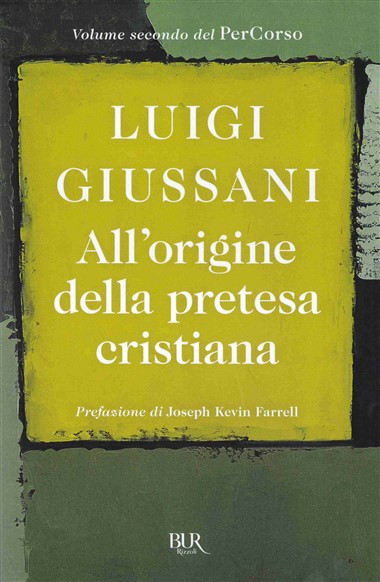
“When facing the hypothesis of Christian revelation, nothing is more important than the question of man’s true situation.” Indeed, without this attentive and impassioned self-awareness, even Christ would become just a name, the answer to a non-existent question.
A true self-awareness always implies, as a last resort, the urgency of those questions about life’s exhaustive meaning that place man in front of the Mystery. In fact, the perception of the existence of an ultimate quid that underlies everything represents the summit of human reason.
Throughout the ages man has reached out in search of it; hence religions and philosophies have emerged, united by the same effort to imagine this relationship with God and the same insurmountable impotence to attain it (in this sense—as attempts—all religions are “true”). At the utmost threshold of any authentic religious journey, man feels a sense of dizzying disproportion between himself and the Infinite. At this dramatic point, he understands that decisive help can only come to him from the initiative of the Mystery itself.
Within the freedom and variety of attempts that are made, a religion may commit only one crime—to say “I am the religion.” However repellent this may sound, this is precisely the Christian claim. It is based on the assumption that the enigmatic presence looming beyond the horizon of everything has penetrated the fabric of history and, with an unimaginable expressive force, has become incarnated in a human “Fact.” This supposition would correspond to the need for revelation, proper to reason, and it would be irrational to exclude it.
Therefore, given the “possibility” of the fact and the “rationality” of the hypothesis, we can only ask ourselves: did it or did it not happen? If it did happen, in fact, this would be the only path to follow because God Himself would have charted it. The occurrence of this fact would revolutionize and overturn the religious method. It would no longer coincide with an intellectual or spiritual effort to imagine the Mystery, but simply with the recognition and adherence to a present reality. This event that happened is precisely the content of the Christian event.
At this point we must first be aware of the nature of the problem. It is neither a problem of opinions or tastes, nor one of analyzing the religious soul. That Christ did or did not say he was God, whether he is God or not, and the fact that he is still reaching us even today, is, first of all, a historical issue, so the method for dealing with it must correspond to it.
In fact, Christianity does not arise like other religions, but is a historical event, as the first pages of the Gospel of John testify. The Mystery has chosen to become a man—Jesus of Nazareth—and to be encountered in the same very human and dramatic way in which we come across a friend. In this encounter a profound correspondence occurs between our own human expectation and the event that is right before us; it was precisely this exceptionality that made John and Andrew exclaim, “We have found the Messiah.” By sharing their lives with that man, then, the certainty that arose in the first instant became—through recurrent and repeated recognition—full certainty, upon which they could rest their whole lives. Jesus’ friends, by being with Him, discovered incomparable characteristics: an unassailable intelligence, an absolute power over nature, a gaze that could read the secret of everyone’s heart, a capacity for endless emotion over the destiny of every person.
Faced with this experienced correspondence, they attached themselves to Him and, from the experience of encountering His exceptional humanity, they were led to the great question about His divinity, “Who are you?” Jesus answered this question through a slow pedagogy, gradually adding elements that suggested the answer, up to the explicit revelation of the divine nature of his own person.
The greatest, most demonstrative “sign” that Jesus is God is the full concordance of His conception of life with man’s deepest expectation: for only God can unveil, preserve and realize the full breadth of human nature. The essential dimensions of such a conception are: the absolute value of the person (Jesus points out that every single person is a direct and exclusive relationship with God and therefore intangible); religiosity as the true source of morality; prayer as expressing our awareness of our dependence on God; and a total gift of self as the deep law of life.
Because of original sin, however, man is incapable of living, in all its completeness, his relationship with God and thus the truth of his humanity. It is the presence of Jesus that continually sustains a person’s freedom by enabling everyone to be themselves. A Christian is thus a person who, in the certainty of Christ’s companionship (faith), walks filled with hope and capable of a new affection for everything (charity).
Two thousand years later, the original nature of the method of Incarnation remains the same, forcing everyone to take a stand: God saves man through man, the encounter with a living human reality. The real problem at hand is “that man recognize it with love.”