

Latest update
17/09/2026
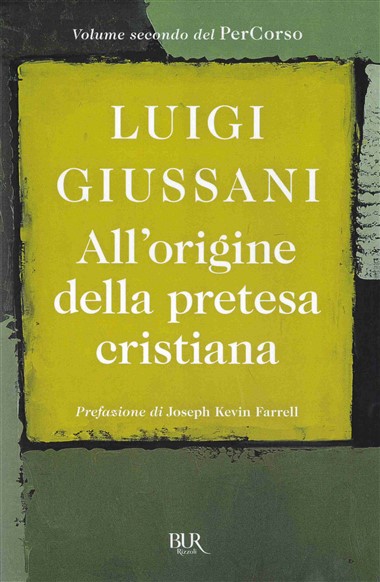
Giussani, Luigi. All’origine della pretesa cristiana: Volume secondo del PerCorso. Prefazione di Kevin Joseph Farrell. Saggi. Milano: BUR Rizzoli, 2025.
“When facing the hypothesis of Christian revelation, nothing is more important than the question of man’s true situation.” Indeed, without this attentive and impassioned self-awareness, even Christ would become just a name, the answer to a non-existent question.
A true self-awareness always implies, as a last resort, the urgency of those questions about life’s exhaustive meaning that place man in front of the Mystery. In fact, the perception of the existence of an ultimate quid that underlies everything represents the summit of human reason.
Throughout the ages man has reached out in search of it; hence religions and philosophies have emerged, united by the same effort to imagine this relationship with God and the same insurmountable impotence to attain it (in this sense—as attempts—all religions are “true”). At the utmost threshold of any authentic religious journey, man feels a sense of dizzying disproportion between himself and the Infinite. At this dramatic point, he understands that decisive help can only come to him from the initiative of the Mystery itself.
Within the freedom and variety of attempts that are made, a religion may commit only one crime—to say “I am the religion.” However repellent this may sound, this is precisely the Christian claim. It is based on the assumption that the enigmatic presence looming beyond the horizon of everything has penetrated the fabric of history and, with an unimaginable expressive force, has become incarnated in a human “Fact.” This supposition would correspond to the need for revelation, proper to reason, and it would be irrational to exclude it.
Therefore, given the “possibility” of the fact and the “rationality” of the hypothesis, we can only ask ourselves: did it or did it not happen? If it did happen, in fact, this would be the only path to follow because God Himself would have charted it. The occurrence of this fact would revolutionize and overturn the religious method. It would no longer coincide with an intellectual or spiritual effort to imagine the Mystery, but simply with the recognition and adherence to a present reality. This event that happened is precisely the content of the Christian event.
At this point we must first be aware of the nature of the problem. It is neither a problem of opinions or tastes, nor one of analyzing the religious soul. That Christ did or did not say he was God, whether he is God or not, and the fact that he is still reaching us even today, is, first of all, a historical issue, so the method for dealing with it must correspond to it.
In fact, Christianity does not arise like other religions, but is a historical event, as the first pages of the Gospel of John testify. The Mystery has chosen to become a man—Jesus of Nazareth—and to be encountered in the same very human and dramatic way in which we come across a friend. In this encounter a profound correspondence occurs between our own human expectation and the event that is right before us; it was precisely this exceptionality that made John and Andrew exclaim, “We have found the Messiah.” By sharing their lives with that man, then, the certainty that arose in the first instant became—through recurrent and repeated recognition—full certainty, upon which they could rest their whole lives. Jesus’ friends, by being with Him, discovered incomparable characteristics: an unassailable intelligence, an absolute power over nature, a gaze that could read the secret of everyone’s heart, a capacity for endless emotion over the destiny of every person.
Faced with this experienced correspondence, they attached themselves to Him and, from the experience of encountering His exceptional humanity, they were led to the great question about His divinity, “Who are you?” Jesus answered this question through a slow pedagogy, gradually adding elements that suggested the answer, up to the explicit revelation of the divine nature of his own person.
The greatest, most demonstrative “sign” that Jesus is God is the full concordance of His conception of life with man’s deepest expectation: for only God can unveil, preserve and realize the full breadth of human nature. The essential dimensions of such a conception are: the absolute value of the person (Jesus points out that every single person is a direct and exclusive relationship with God and therefore intangible); religiosity as the true source of morality; prayer as expressing our awareness of our dependence on God; and a total gift of self as the deep law of life.
Because of original sin, however, man is incapable of living, in all its completeness, his relationship with God and thus the truth of his humanity. It is the presence of Jesus that continually sustains a person’s freedom by enabling everyone to be themselves. A Christian is thus a person who, in the certainty of Christ’s companionship (faith), walks filled with hope and capable of a new affection for everything (charity).
Two thousand years later, the original nature of the method of Incarnation remains the same, forcing everyone to take a stand: God saves man through man, the encounter with a living human reality. The real problem at hand is “that man recognize it with love.”
«Nell’affrontare il tema dell’ipotesi della rivelazione cristiana, nulla è più importante della domanda sulla reale situazione dell’uomo». Senza questa coscienza attenta e appassionata di se stessi, infatti, anche quello di Cristo diverrebbe un puro nome, una risposta a una domanda inesistente.
Una coscienza vera di sé implica sempre, in ultima istanza, l’urgenza di quelle domande sul significato esauriente del vivere che pongono l’uomo di fronte al Mistero. La percezione dell’esistenza di un quid ultimo che sottende ogni cosa rappresenta, infatti, il vertice dell’umana ragione.
In tutti i tempi gli uomini si sono protesi alla ricerca di esso; di qui sono nate religioni e filosofie, accomunate dal medesimo sforzo di immaginare il rapporto con Dio e dalla stessa insuperabile impotenza a raggiungerlo (in questo senso – come tentativi – tutte le religioni sono «vere»). All’estrema soglia di ogni autentico percorso religioso, l’uomo percepisce un senso di vertiginosa sproporzione tra sé e l’Infinito. In questo punto drammatico, egli comprende che l’aiuto decisivo gli può venire unicamente dall’iniziativa del Mistero stesso.
Nella libertà dei tentativi se c’è un delitto che una religione può compiere è quello di dire: «Io sono la religione». Per ripugnante che possa essere, questa è esattamente la pretesa cristiana. Essa si basa sull’ipotesi che l’enigmatica presenza, che incombe oltre l’orizzonte di ogni cosa, sia penetrata nel tessuto della storia, e con forza espressiva inimmaginabile si sia incarnata in un «Fatto» umano. Questa supposizione corrisponderebbe all’esigenza della rivelazione, propria della ragione, e sarebbe irrazionalità escluderla.
Data la «possibilità» del fatto e la «razionalità» dell’ipotesi, resta dunque una sola cosa da chiedersi: è accaduto o no? Se fosse realmente accaduta, infatti, questa sarebbe l’unica strada perché l’avrebbe tracciata Dio stesso. L’accadere di questo fatto rivoluzionerebbe, capovolgendolo, il metodo religioso. Esso non coinciderebbe più con uno sforzo intellettuale o spirituale di immaginare il Mistero, ma semplicemente con un riconoscimento e una adesione a una realtà presente. Che questo fatto sia accaduto è precisamente il contenuto dell’avvenimento cristiano.
A questo punto occorre, innanzitutto, rendersi conto della natura del problema. Esso non riguarda una questione di gusti o pareri né di analisi dell’animo religioso. Che Cristo abbia detto o no di essere Dio, che sia o non sia Dio e che ci raggiunga ancora oggi è, innanzitutto, un problema di carattere storico, perciò il metodo per affrontarlo deve essere adeguato.
Il cristianesimo non nasce, infatti, come le altre religioni, ma è un avvenimento storico, come testimoniano le prime pagine del vangelo di Giovanni. Il Mistero ha scelto di diventare un uomo – Gesù di Nazareth – e di farsi incontrare con la stessa modalità, umanissima e drammatica, con la quale ci si imbatte in un amico. In questo incontro accade una corrispondenza profonda tra la propria attesa umana e l’avvenimento che si ha di fronte; è questa eccezionalità che permise a Giovanni e Andrea di esclamare: «Abbiamo trovato il Messia». Nella convivenza con quell’uomo, poi, la certezza insorta nel primo istante divenne, in un successivo ripetersi di riconoscimenti, certezza compiuta sulla quale poggiare tutta la vita. Gli amici di Gesù, stando con lui, ne scoprirono caratteristiche incomparabili: un’intelligenza inattaccabile, un potere assoluto sulla natura, uno sguardo in grado di leggere il segreto del cuore di ogni uomo, una capacità di commozione senza fine per il destino di ogni persona.
In forza di questa corrispondenza sperimentata, si attaccarono a lui e furono condotti dall’esperienza dell’incontro con la Sua eccezionale umanità alla grande domanda circa la Sua divinità: «Chi sei tu?». A questa domanda Gesù rispose attraverso una lenta pedagogia, aggiungendo progressivamente elementi che suggerirono la risposta, fino alla rivelazione esplicita della natura divina della propria persona.
Il «segno» più grande, più dimostrativo del fatto che Gesù è Dio è l’assoluta consonanza tra la sua concezione della vita e l’attesa profonda dell’uomo: solo Dio, infatti, può svelare, conservare e realizzare tutta l’ampiezza della natura umana. Le dimensioni essenziali di tale concezione consistono nel valore assoluto della persona (Gesù porta a galla che ogni singolo uomo è rapporto diretto ed esclusivo con Dio e perciò intangibile), nella religiosità quale vera sorgente di moralità, nella preghiera come espressione della coscienza della dipendenza vissuta da Dio e nel dono totale di sé quale legge profonda della vita.
Per il peccato originale, però, l’uomo si trova incapace a vivere compiutamente il rapporto con Dio e quindi la verità della sua umanità. È la presenza di Gesù che continuamente sostiene la libertà della persona rendendola capace di essere se stessa. Il cristiano è dunque un uomo che nella certezza della compagnia di Cristo (fede) cammina pieno di speranza e capace di un’affezione nuova a tutto (carità).
Duemila anni dopo la natura originale del metodo dell’Incarnazione resta identica, costringendo chiunque a prendere posizione: Dio salva l’uomo attraverso l’uomo, l’incontro con una realtà umana viva. Il vero problema diventa solamente «che l’uomo lo riconosca con amore».
