

Latest update
05/06/2025
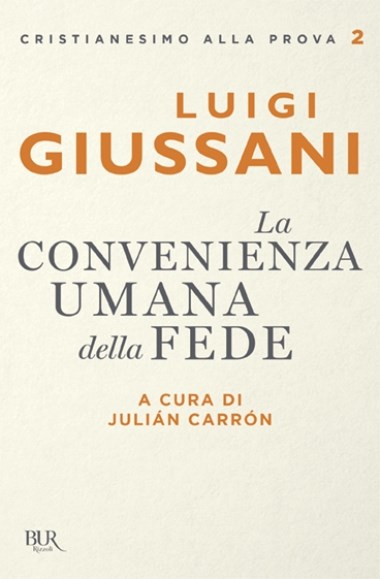
Giussani, Luigi. La convenienza umana della fede. A cura di Julián Carrón. Cristianesimo alla prova, 2. Milano: BUR Rizzoli, 2018.
Secondo volume della nuova serie “Cristianesimo alla prova” in cui sono riprodotte le lezioni, i dialoghi e le omelie dell’Autore durante gli Esercizi spirituali della Fraternità di Comunione e Liberazione.
Come si legge nell’ampia Nota editoriale, i testi sono stati redatti a partire da trascrizioni di registrazioni. Questo metodo si è reso necessario per il fatto che Giussani ha svolto lungo il corso della sua vita un’instancabile attività educativa, è accaduto quindi che gran parte del suo pensiero si sia comunicato attraverso la ricchezza e il ritmo di un discorso orale e sia giunto a noi mediante registrazioni audio e video conservate presso l’Archivio della Fraternità di Comunione e Liberazione a Milano.
I testi raccolti nel presente volume sono stati elaborati attenendosi ai criteri formulati a suo tempo dallo stesso Giussani: fedeltà ai discorsi nella forma in cui sono stati pronunciati; rispetto della natura dei discorsi (in relazione all’occasione in cui sono stati pronunciati); minime variazioni per favorire la resa scritta di un pensiero comunicato oralmente (cfr. p. 6).
Apre il volume la Prefazione di Julián Carrón dal titolo “Nacque il tuo nome da ciò che fissavi” (pp. I-XVII).
Gli scritti proposti coprono un arco di tempo di tre anni: dal 1985 al 1987.
Ogni parte è introdotta da una breve nota storica a cura dei redattori, in corsivo nel testo.
La prima parte, “Ricominciare sempre: 1985” (pp. 7-113), riporta gli Esercizi della Fraternità che ebbero luogo a Rimini nel marzo 1985. Per far fronte all’aumentato numero di partecipanti, gli Esercizi si tennero in due turni, a distanza di una settimana l’uno dall’altro (15-17 e 22-24 marzo).
Come dichiarato (p. 11), fatta eccezione per il primo paragrafo, l’“Introduzione” propone quanto detto al secondo turno (pp. 11-20); si tratta di un testo inedito. Gli scritti restanti, invece, riguardano il primo turno.
Alcune parti del volume hanno avuto precedenti pubblicazioni:
- A breve distanza dagli Esercizi, fu editato un libretto pro manuscripto destinato alla circolazione interna al Movimento: Esercizi Spirituali della Fraternità di Comunione e Liberazione: Appunti dalle meditazioni (TIEMME, 1985. Testi non rivisti dall’Autore). In esso sono riportate le sintesi delle lezioni tenute dall’Autore.
L’“Introduzione” (1985, pp. 3-4) corrisponde a parte dell’“Omelia” durante la messa del venerdì sera (BUR, 2018, pp. 21-23).
La “Prima lezione” tenuta il sabato mattina (1985, pp. 5-14) corrisponde a parte del testo “Apparteniamo a un Altro” (2018, pp. 24-40).
La “Seconda lezione”, svoltasi il sabato pomeriggio (1985, pp. 15-28), corrisponde a parte di “Vivere l’ideale nell’istante” (2018, pp. 41-66).
La “Terza lezione” (1985, pp. 29-36) corrisponde a parte del capitolo “La vera convenienza” (2018, pp. 93-113).
Nella nuova pubblicazione BUR, 2018, sono stati corretti i refusi presenti nel testo del 1985.
- Nel 2002 parte della terza lezione è stata pubblicata anche nel volume L’opera del movimento: La Fraternità di Comunione e Liberazione: In occasione del ventesimo anniversario del riconoscimento pontificio con il titolo “Esercizi della Fraternità, primo turno, 15-17 marzo 1985” (San Paolo, 2002 e 2011, pp. 78-81. Con successive traduzioni).
Nello stesso volume è stata pubblicata in forma integrale anche l’“Assemblea” (2018, pp. 73-92) svoltasi sabato (“Esercizi della Fraternità: Primo turno, 16 marzo 1985”, San Paolo, 2002 e 2011, pp. 183-198. Con successive traduzioni).
Sono invece testi inediti il breve paragrafo “Avvisi” (2018, p. 23), l’“Omelia” del sabato e quella della domenica (BUR, 2018, pp. 67-72, pp. 110-113).
La seconda parte, “Il volto del Padre: 1986” (pp. 115-199), riporta gli Esercizi svoltisi a Rimini dal 4 al 6 aprile 1986. Anche in quell’anno gli Esercizi si tennero in due turni per soddisfare le numerose richieste di partecipazione. Giussani fu presente a partire dal sabato mattina perché la sera del 4 aprile era stato ricevuto in udienza privata da Giovanni Paolo II (cfr. p. 116). I testi qui pubblicati si riferiscono al primo turno.
- Una sintesi delle lezioni fu pubblicata quello stesso anno in un libretto pro manuscripto destinato alla circolazione interna al Movimento: Esercizi Spirituali della Fraternità di Comunione e Liberazione: Appunti dalle meditazioni (TIEMME, 1987. Testi non rivisti dall’Autore).
Il capitolo “Prima lezione: sabato 5 aprile mattino” (1986, pp. 5-16) propone in forma sintetica i testi pubblicati nel presente volume con i titoli “Introduzione alle Lodi” e “La coscienza del Padre” (BUR, 2018, pp. 117-145).
La “Seconda lezione” (1986, pp. 17-28) è la sintesi di quanto detto il sabato pomeriggio e corrisponde a parte del capitolo “Nacque il tuo nome da ciò che fissavi” (2018, pp. 146-170).
La “Terza lezione” (1986, pp. 29- 42) è la sintesi di quanto detto la domenica mattina e corrisponde a parte del capitolo “Icaro, il rapporto con l’infinito” (2018, pp. 171-197).
- Alcuni brani, tratti dalle lezioni del sabato pomeriggio e della domenica mattina, nel 2002 sono stati pubblicati in L’opera del movimento: La Fraternità di Comunione e Liberazione (“Esercizi della Fraternità: 4 - 6 aprile 1986”, San Paolo, 2002 e 2011, pp. 82-87; BUR, 2018, pp. 162-163, pp. 166-167, pp. 177-180, pp. 182-183).
Sono inediti l’“Omelia” del sabato, quella della domenica (BUR, 2018, pp. 167-170, pp. 198-199) e il testo “Avviso” (2018, pp. 197-198).
La terza parte, “Sperimentare Cristo in un rapporto reale e storico: 1987” (pp. 203-267), riporta gli Esercizi svoltisi a Rimini dal 13 al 15 marzo 1987. Essi si tennero in un unico turno, formula che non sarebbe più stata abbandonata.
Una versione sintetica di quanto detto durante le lezioni fu pubblicata nel 1987 nel libretto pro manuscripto destinato alla circolazione interna al Movimento: Esercizi Spirituali della Fraternità: Appunti dalle meditazioni (TIEMME, 1986. Testi non rivisti dall’Autore).
Il capitolo “Introduzione: venerdì 13 marzo, sera” (1987, pp. 3-7) propone in forma sintetica i testi editi nel presente volume con i titoli “Introduzione” e “Omelia” (BUR, 2018, pp. 205-211).
La “Prima lezione: sabato 14 marzo, mattina” (pp. 9-20) corrisponde a parte del testo “Come Zaccheo” (2018, pp. 215-236).
La “Seconda lezione: sabato 14, pomeriggio” (pp. 21-30) è la sintesi di quanto detto il sabato pomeriggio e corrisponde a parte del capitolo “Nella carità la memoria diventa opera” (2018, pp. 237-252).
La “Terza lezione: domenica 15, mattina” (pp. 31-38) è la sintesi di quanto detto la domenica e corrisponde a parte del capitolo “La gloria di Cristo” (2018, pp. 254-267).
Sono, invece, testi inediti i paragrafi “Avvisi” (2018, p. 211) e “Introduzione alle Lodi” (2018, p. 214, p. 253).
Il volume si chiude con le “Fonti” (p. 269), gli “Indici” (pp. 271-292) e il “Sommario” (pp. 293-295). [P. M.]
1985
Always Starting Again
The burden of fragility and inconsistency lies inside our own flesh. And yet, within this nothingness there persists in us a sense of destiny that cannot be removed by even the craziest education but needs to be developed, otherwise it comes down to something extraneous that will be able to crush us like lead. It is the cry for forgiveness that makes us change again as it brings the serious nature of restlessness back to us and lets us identify it with our hearts. This is possible because we do not belong to ourselves but we belong to Another.
Only the encounter with Christ makes our search for meaning organic and sets us free, assigning us with endless joy, starting from the present. First of all, it generates a clear awareness of God as a Father, a Father who, above all things, is merciful; moreover, He fights the source of sin that is within us and that declines into forgetfulness, skepticism, and trust in the works of our hands. And here exactly is the alternative—either you love Christ and, in the impetus of the moment, embrace the whole world or you love yourself and, this way, the ephemeral builds nothing, is useless. What can help us most is authority, because it gives no respite reminding us that the fulcrum in life is “One amongst us,” Christ. But authority cannot be there if it is not based on a community, that is the visible and sensitive aspect of the fact we belong to. In the face of authority and community what we need to develop in ourselves is precisely our consciousness of belonging. Then the rule of life, even when faced with objections, is to follow, and this means not so repeating things or carrying out schemes, but reviving in us an attitude of judgment and affection in everything we do.
1986
The Face of the Father
What happens when I become a Christian and submit myself to the name of Christ by taking Him as the rule of all my actions? First, I become aware that moment by moment my life depends on the Father and exists in function of the Father. In fact, Christ’s awareness continually mirrored the Father, “Whoever has seen Me has seen the Father.” Modern people conceive conscience as the source of criteria; instead, for Christians, conscience is the place where you seek and listen to the truth of Another. Thinking about the Father, as Christ did, is thus a true way of thinking about things—it is the truest and most intense look you bring to your wife or husband, to your children, to your work, to the good or the bad things. Sin is the faltering of the striving to have the consciousness of this relationship happen, a relationship without which life is less human, less reasonable. Choosing for or against this consciousness depends on how freedom is played out; this, together with the mystery of Christ, is the greatest mystery there is. Freedom is an expression of yourself even in sacrifice, which means affirming not your own measure but that of Another—to regain this relationship, you must tear yourself away from your own measure and keep your eyes fixed “where true joy is”; this sacrifice, as a condition of freedom, generates genuine love and brings about true fraternity among men and women, which is a life of relationships in the faith.
There are figures, such as Matisse’s Icarus or Dante’s Ulysses, who represent the impetus of the human heart striving for truth. Yet they are filled with tragedy because their human condition prevents them from reaching their goal. But ever since the Father made Himself a presence, this has become possible—Icarus is now the man who has come to know the Lord and thanks to this he fully lives his life in his relationship with the cosmos and all his actions are measured according to his relationship with God. If all of our gestures are not in relationship with the infinite, they become a prison. This is why we must stick to our companionship—through it, Christ penetrates time and space, and we can make memory of Him every moment, in obedience, virginity and mutual charity.
1987
Experiencing Christ in a Real and Historical Relationship
“Christ” is the only word that gives us hope. When Zacchaeus heard his name called, in an instant he felt totally liberated. However artificial it may be to think that he made no mistakes after that moment, he was not the same as before. We are loved more than we err; Christ’s resurrection has set us free from sin so that evil, that still remains in us, becomes an occasion for grief and conversion to Him. The only thing we have to do, then, is to keep our eyes fixed on Jesus—we just need to look at Him again, think about Him, and we are forgiven. The word Christ used to indicate this return to Him is “memory.” Morality is not an ability we have but the possibility of Christ within us—thus, the matter lies in the fact that what is already present deep inside us may manifest itself, and this manifests itself the more we make memory of Christ.
Memory, then, cannot help but turn into “living action.” There are three terms of this “incarnation” of memory. First of all, memory becomes a living rule as it purifies one’s relationship with everything, that is, it makes all human gestures truer. This is charity—love for the great Presence without which man becomes clouded in his own self-interests. In the second place, memory is accomplished in patience, which is the certainty that Christ will fulfill what He has promised. Finally, memory experienced as rule, purification, love of the ideal and patience becomes a presence that communicates, that is, a movement—a tangible presence, attentive to concrete needs and generating works. A work is first and foremost one’s daily work experienced in its connection with the total design; this, over time, changes society.
We have been called to bring into the world a new logic, that is the logic of love. The greatest division in the history of human culture is produced by the formula “glory of Christ”—a life looked at and addressed for the glory of Christ establishes a position that is unparalleled. Therefore, if our personality is to be marked by several inflections in relation to others, the first of these flections is to demand that Christ come into our lives. The second is intelligence, which means that our personality must have a different kind of judgment from all the common mentality; and, third, this new personality has an energy called freedom or affectivity—arising from a judgment—whose criterion remains the glory of Christ. This new person experiences two disparate circumstances—companionship and grief. It is only in a new humanity that we experience peace, which comes from gladness, and gratitude is the symptom that we are walking.
