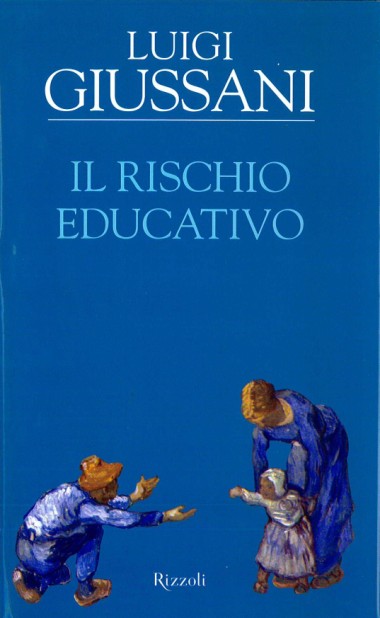
Giussani, Luigi. Il rischio educativo. Milano: Rizzoli, 2014.

Il rischio educativo
Giussani Luigi  Author
Lobkowicz Nikolaus  Preface

Rizzoli Italian 2014 Pages: 140

Latest update
05/06/2025


Giussani, Luigi. Il rischio educativo. Milano: Rizzoli, 2014.


Full Text

Editorial History

Riedizione dell’opera Il rischio educativo (Rizzoli 2005). 
Il testo di Giussani è invariato (corretti alcuni refusi nel testo e nelle note, in particolare si segnala la nota 39, 2005 e 2014, p. 92), è stata però aggiunta la Nota di edizione che riassume in breve le complesse vicende editoriali di questo scritto (p. 4). 

L’opera Il rischio educativo è pubblicata per la prima volta da Jaca Book nel 1977 e successivamente rieditata nel 1988 (Jaca Book), nel 1994 (nel secondo dei due volumi che raccolgono gli scritti dell’Autore pubblicati da Jaca Book; Opere: 1966-1992. Vol. 2: Il rischio educativo, pp. 481-555) e nel 1995 (nel volume miscellaneo Il rischio educativo: Come creazione di personalità e di storia, SEI, 1995, pp. 3-56; quest’ultima pubblicazione contiene anche altri testi dell’Autore sul tema dell’educazione dei giovani).

Nel 2005 viene riproposto, per i tipi di Rizzoli, il nucleo originario dell’opera (che corrisponde alle parti “Dinamica e fattori dell’avvenimento educativo”, “Crisi e dialogo” e “Struttura dell’esperienza”, dell’edizione Jaca Book, 1977, pp. 11-95), con gli aggiornamenti voluti dall’Autore per le edizioni successive: il capitolo “Spunti introduttivi” aggiunti nell’edizione Jaca Book, 1988 (“Spunti introduttivi per la nuova edizione”, 1988, pp. 9-29; Rizzoli, 2014 e 2005, pp. 41-64); la Prefazione di Nikolaus Lobkowicz e l’“Introduzione” di Giussani redatte per l’edizione SEI, 1995 (2014 e 2005, pp. 5-38; SEI, 1995, pp. VII-XXV).
In occasione della ripubblicazione Rizzoli è stato operato un importante lavoro di revisione. Rispetto alle precedenti pubblicazioni sono stati espunti la Nota di edizione al volume Jaca Book 1977 (1977, pp. 9-12; 1988, pp. 33-35) e la parte “Conversazione con Luigi Giussani” (1977, pp. 97-110; 1988, pp. 101-111; SEI, 1995, pp. 157-162); i capitoli “Viterbo 1977” e “Insistenza”, presenti nella miscellanea edita da SEI nel 1995 (pp. 57-173). Inoltre, alla pagina 126 è stato corretto un errore presente in tutte le edizioni successive alla prima: il “Nota bene” che era stato erroneamente spostato in nota (Jaca Book, 1988, p. 95; SEI, 1995, p. 53) è stato riportato nel testo, dove si trovava nell’edizione Jaca Book del 1977 (p. 89).
La struttura del testo (suddivisione in capitoli e paragrafi) è quella dell’edizione SEI, 1995. 
Il volume è stato pubblicato nel luglio 2005, successivamente alla morte dell’Autore avvenuta il 22 febbraio di quell’anno.

L’“Introduzione” (2014 e 2005, pp. 15-38) è la rivisitazione dell’intervento di Giussani alla conferenza “Un esempio di comunicazione religiosa”, tenutasi a Milano il 10 marzo 1995 in occasione del Salone del libro religioso. Prefazione e “Introduzione” sono state pubblicate in Litterae Communionis-Tracce (8 1995: inserto. Con successive traduzioni) con il titolo “Il rischio educativo. Come creazione di personalità e di storia”; brani dall’“Introduzione” sono stati pubblicati col titolo “Meglio educare che reprimere” in Il Giornale (24 settembre 1995, p. 16) e “Giussani, la sfida di educare” in La Stampa (6 ottobre 1995, p. 20).

Segue il testo “Il rischio educativo” nella stessa forma (suddivisione capitoli e paragrafi) in cui è stato proposto da SEI (“Parte prima. Il rischio educativo”, 1995, pp. 3-56), comprensivo quindi degli “Spunti introduttivi” (2005, pp. 41-64) stesi nel giugno 1986 per l’edizione del testo in lingua francese (Le risque éducatif, Nouvelle Cité, 1987, pp. 7-25) e inseriti nella riedizione italiana del 1988 (“Spunti introduttivi per la nuova edizione”, in Il Rischio educativo, Jaca Book, 1988, pp. 9-29). Il paragrafo “Tempi e contesti nell’attuazione di un metodo” (pp. 58-64), relativo a questa parte introduttiva, è stato pubblicato anche in Realtà e giovinezza. La sfida (SEI, 1995, pp. 158-161. Nuova edizione: Rizzoli, 2018, pp. 199-203) con il titolo “Ragione e compagnia”.

Il capitolo primo “Dinamica e fattori dell’avvenimento educativo” (pp. 65-110) è l’edizione riveduta e corretta dall’Autore del testo Adolescente, famiglia, scuola estratto dall’Enciclopedia dell’adolescenza (a cura di A. Valsecchi, Editrice Queriniana, 1965, pp. 263-286), ma riprende anche scritti del 1960.

L’origine del testo “Crisi e dialogo”, che costituisce il capitolo secondo, (pp. 111-125) è l’intervento di Giussani al IX congresso C.I.S.S. (Centro Italiano Stampa Studentesca) svoltosi a Loreto nel novembre 1963; il testo è stato pubblicato negli Atti del IX congresso C.I.S.S. (fascicolo monografico di Bollettino del Centro Italiano Stampa Studentesca, 1963) con il titolo “I giovani per la costruzione di una società nuova”. Nel 1964, dopo attenta revisione (aggiunta la “Conclusione” ­– Rizzoli, 2005, pp. 124-125 – e il titolo dei paragrafi, espunte alcune parti esemplificative), lo scritto è stato pubblicato con il titolo “Crisi e dialogo” nella rivista Okara (7 1964: pp. 3-5). Nel 1977 infine è confluito nella prima edizione del Rischio educativo (Jaca Book, 1977, pp. 67-86; espunto il penultimo periodo della parte intitolata “Situazione di oggi”, 1964, p. 5; 2005, pp. 123-124); il testo è presente in forma identica nelle edizioni Jaca Book 1988 e 1994 e nel volume miscellaneo SEI, 1995. Nella presente edizione il paragrafo “Dialogo” è intitolato “Apertura dialogica”, come nell’edizione 1977 (1977, p. 79; 2005, p. 120).

Il capitolo terzo “Struttura dell’esperienza” (pp. 126-132) è il testo del libretto L’esperienza (Gioventù Studentesca, 1963) scritto in risposta a una lettera dell’allora cardinale di Milano G.B. Montini, già presente nelle edizioni del 1977 e del 1988 e ripubblicato nel gennaio 1988 in Il Sabato con il titolo “L’esperienza del Mistero” (16, 1988, p. 18), nel 2002 in Litterae Communionis-Tracce con il titolo “L’esperienza” (4 2002: inserto. Con successive traduzioni) e nel 2009 in Litterae Communionis-Tracce con il titolo “La struttura dell’esperienza” (10 2009: inserto. Con successive traduzioni). Nel 1964, il paragrafo “L’esperienza cristiana” (punti a, b, c; 2005, pp. 130-132) è riportato anche in Appunti di metodo cristiano all’interno del paragrafo “L’incontro come esperienza” nel volume miscellaneo Il cammino al vero è un’esperienza (Rizzoli, 2006, pp. 155-157; prima edizione Appunti di metodo cristiano, Gioventù Studentesca, 1964, pp. 44-45).

Chiudono il volume gli indici (pp. 133-140). [P. M.]

Summary of contents

The great problem of any human society is the education of young people, because it is through them that the future is built. Therefore, what their education consists of and how it is carried out becomes the fundamental issue of a community-based concern. 
The essential purpose of any commitment to education is to bring out the humanity of the individual, and first and foremost that “heart” that is mentioned by the Bible and the Author understands as the “complex of original needs and evidences” each person is endowed with. Christianity is committed to this same dynamic. For the challenge it is called to undertake is to demonstrate the supreme rationality of faith, that is, its insuperable relevance and capacity to correspond to life in all its aspects and expectations. Therefore, it is essential to rediscover a method by which faith can be communicated in a reasonable, that is, adequate, way, and that can help verify it in life.

The Dynamic and Elements of the Educational Event
What do we mean by “education”? “Education,” the Author remarks, is an “introduction to the total reality,” where the word “total” indicates both developing all the structures within an individual and affirming all the possibilities those structures have to connect with all of reality. However, we never truly affirm reality unless we affirm the existence of its meaning. Therefore, no education can occur without communicating some idea of meaning that the individual in formation considers to be sufficiently solid, intense, sure. 
According to the Author, the essential guidelines for an educational dynamic are: loyalty to tradition, an authority figure who can communicate it, and a personal verification of the hypothesis. If we understand by the word “tradition” that structure of values and meanings into which the individual is born, the first guideline for educating people is to loyally adhere to this tradition. For without tradition, we could take no steps in the world, and the formation of our personality would be left to an evolving spontaneity. 
In order for the force of tradition to become persuasive in life, however, it needs to be conveyed by the existentiality of a proposal, by an authority figure in whom it is clearly embodied, giving reason for itself. Therefore, authority is not something external that is added on to the life of the individual to whom the educational proposal is addressed; in a certain sense, authority is the truest “I” of the person who is being educated. Parents are, first and foremost, authorities, whether they are aware of it or not. Their task is then continued by schools—the function of teachers, precisely, is to offer a hypothesis to verify through a comparison with everything. 
To effectively respond to the educational need, the educator must finally arouse in adolescents a personal engagement to verify the proposal of meaning that has reached them. Namely, an adult must invite them to carry out a continuous “comparison” between this proposal and what happens to them. Conviction can only come from the experience of finding that an idea we have embraced or received is vitally linked with our own needs and projects. 
The first condition necessary for young people to verify their hypothesis is that they be helped to find out the truth of the proposal in their environment. Only in the environment—that is, the cultural and social context in which they live in and from within which they draw inspiration, promptings and challenges—will the validity of the education they have received become clear. The second condition demands that young people not carry out their verification in a solitary way, but in a communal way; for community is not just a convergence from the outside, but an essential dimension of the person. The third condition is that it involves the use of free time—a proposal is truly embraced if it affects the way young people use their free time, the time they can dispose of as they wish. For it is here that an idea turns to a responsibility that is knowledgeably taken on. 
In verifying the educational proposal, all dimensions of the person are involved (a hypothesis of meaning is true, in fact, if it responds to all the original needs of human beings and implements their development): “culture,” as the need for a total explanation of reality; “charity,” as the need for absolute radicalness in love; “mission,” as the need for a totality of horizons for which their humanity is made. 
Now, the evolution of the adolescent’s independence is a “risk” for the intelligence and heart—and also for the egotism—of the educator. But it is only from this love for freedom to the point of risk that a mature personality is formed in a young person. Educators, as such, are therefore called to retreat behind the dominating form of the One Truth that is their inspiration, to cling not to themselves, but to something greater they themselves depend and live upon. At the conclusion of the educational process, the educator has introduced the pupil into the total reality. It is up to young people to continue their journey in the firm conviction of the positivity of things and the certainty of their significance.  This is the start of a new companionship between the educator and the educatee, as a permanent and mutual help to adhere to the call of being in every instant of their life, to work together, side by side, towards a destiny that unites us all.

Crisis and Dialogue
As emphasized by the Author in Chapter Two, “crisis” and “dialogue” are the two relevant factors within any educational journey. The word “crisis”—that a dominant mentality perceives in a negative sense, as if it necessarily implied doubt and denial—is closely related to the word “problem.” In everyone’s journey, the original given or “tradition” must eventually “become crisis,” that is, tradition must become a “problem.” In other words, when facing the questions raised by life, a young person is personally called to sift through and test so as to detect the values it contains and reject whatever is not a value.
Whereas “dialogue” indicates our relationship with the “other”, and the figure of the other is crucial for our own growth. But true dialogue can only exist to the extent that we all bring an “awareness of ourselves” and stand in an attitude of “openness” toward the other. Without these two factors, we face an extremely grave danger—that of confusing dialogue with compromise.

The Structure of Experience
Finally, in the Author’s thought, the idea of “experience” is crucial, perceived as “living what makes me grow.” Experience entails the fact of realizing that we are growing, and thus implies the ability to understand and the ability to love. What characterizes experience, then, is not so much doing but rather understanding something, discovering its meaning, a meaning that we do not create and to which we have to adhere. “Nature” is the locus of experience. The characteristic of nature is that it builds an organic and hierarchical fabric that stimulates the need for unity rooted in every person. This tension toward unity is hindered when an individual element of existence is isolated from its relationship to the whole of reality. This way, life turns into a series of disjoined partialities.
The intervention of Christ in history had the function of pointing to God as the ultimate implication of human experience, and to religiosity as an inevitable dimension of authentic life. But when it comes to Christ, His exceptionality lies not so much in the fact that He serves as a reminder of the Mystery, but rather in the fact that His occurrence is the physical presence of that ultimate meaning of history. Thus, nature is no longer the only locus of the relationship that causes the human person to grow. There is also a locus that is both “supernatural” and historical—the Church, the Mystical Body of Christ. 
Therefore, the experience of Christianity occurs as a single, vital act, and it is composed of three elements: a) an encounter with an objective fact, whose existential reality is a tangible community; b) the power to adequately perceive the meaning of this encounter, that is, the grace of faith; c) the awareness of the correspondence between the meaning of the Fact we have come across and the meaning of our own existence, our ultimate destiny. It is through this “verification” that, in Christian experience, divine grace valorizes human reason and that human freedom shows itself in its full stature. All the drama of freedom lies in living this “poverty of spirit” that alone enables us to embrace the fact of Christ.

Translations

English - The Risk of Education: Discovering Our Ultimate Destiny - Giussani - McGill-Queen's University Press - 2019

Related publications

1963 - "I giovani per la costruzione di una società nuova." In Atti del IX congresso C.I.S.S. - Giussani - [s.n.] - Italian
1963 - L'esperienza - Giussani - Gioventù Studentesca - Italian
1964 - Appunti di metodo cristiano - Giussani - Gioventù Studentesca - Italian
1964 - Crisi e dialogo - Giussani - Okara - Italian
1965 - "Adolescente, famiglia, scuola." In Enciclopedia della adolescenza - Giussani - Queriniana - Italian
1977 - Il rischio educativo - Giussani - Jaca Book - Italian
1988 - Il rischio educativo - Giussani - Jaca Book - Italian
1988 - L'esperienza del mistero - Giussani - Il Sabato - Italian
1994 - Opere: 1966-1992: Vol. 2 - Giussani - Jaca Book - Italian
1995 - Il rischio educativo. Come creazione di personalità e di storia - Giussani, Lobkowicz - Litterae Communionis-Tracce - Italian
1995 - Prefazione a Il rischio educativo: Come creazione di personalità e di storia, di Luigi Giussani - Giussani, Lobkowicz - SEI - Italian
1995 - Realtà e giovinezza. La sfida - Giussani - SEI - Italian
2002 - L'esperienza - Giussani - Litterae Communionis-Tracce - Italian
2005 - Il rischio educativo - Giussani, Lobkowicz - Rizzoli - Italian
2006 - Il cammino al vero è un'esperienza - Giussani, Schönborn - Rizzoli - Italian
2009 - La struttura dell'esperienza - Giussani - Litterae Communionis-Tracce - Italian
2018 - Realtà e giovinezza. La sfida - Giussani, Carrón - Rizzoli - Italian

Translations of Related Publications

Albanian - Rreziku Edukativ - Giussani - [Associazione Internazionale per la Solidarietà shis] - 2011
Arabic - Il rischio educativo [Edizione in lingua araba] - Giussani - Tawasul Center - 2011
Czech - Předmluva: Mikuláš Lobkowic k Riziko výchovy, Luigi Giussaniho - Giussani, Lobkowicz - Zvon - 1996
Czech - Smysl Charitativy: Cíl, dusledky, pokyny - Giussani - Fraternità di Comunione e Liberazione - 2019
French - Le Risque éducatif - Giussani - Nouvelle Cité - 1987
French - Le risque éducatif. Comme création d'une personnalité et d'une histoire - Giussani - Litterae Communionis-CL - 1995
French - L'expérience - Giussani - Litterae Communionis-Traces - 2002
French - Le Risque éducatif - Giussani - Nouvelle Cité - 2006
French - La structure de l'expérience - Giussani - Litterae Communionis-Traces - 2009
French - Traces d’expérience chrétienne - Giussani - Fraternità di Comunione e Liberazione - 2018
English - Education: The Introduction to Reality in Its Entirety - Giussani - Journey-The CL Magazine - 1996
English - Experience - Giussani - Litterae Communionis-Traces - 2002
English - The Journey to Truth is an Experience - Giussani - McGill-Queen's University Press - 2006
English - The Structure of Experience - Giussani - Litterae Communionis-Traces - 2009
Dutch - Òf het niets. Òf het omhelzen van een ander - Giussani - Litterae Communionis-CL - 1995
Dutch - Het risico van de opvoeding - Giussani - Stichting Levende Mens - 2010
Polish - Przedmowa do Ryzyko wychowawcze: Jako tworzenie osobowości i historii, Luigiego Giussaniego - Giussani, Lobkowicz - Wydawnictwo Jedność - 2002
Portuguese - Prefácio a Educar é um risco: Como criação de personalidade e de história, de Luigi Giussani - Giussani, Lobkowicz - DIEL - 1998
Portuguese - Realidade e juventude. O desafio - Giussani - DIEL - 2003
Portuguese - Educar é um risco - Giussani - DIEL - 2006
Portuguese - O caminho para a verdade é uma experiência - Giussani - Edições Tenacitas - 2007
Portuguese - A estrutura da experiência - Giussani - Litterae Communionis-Passos ediçao portuguesa - 2009
Portuguese - Prefácio a Educar é um risco, de Luigi Giussani - Giussani, Lobkowicz - Paulus Editora - 2018
Portoghese BR - A experiência do mistério - Giussani - CL-Comunhão e Libertação - 1988
Portoghese BR - Educar à missão - Giussani - CL-Comunhão e Libertação - 1991
Portoghese BR - Prefácio a Educar é um risco: Como criação de personalidade e de história, de Luigi Giussani - Giussani, Lobkowicz - Companhia Ilimitada - 2000
Portoghese BR - A experiência - Giussani - Litterae Communionis-Passos - 2002
Portoghese BR - Prefácio a Educar é um risco: Como criação de personalidade e de história, de Luigi Giussani - Giussani, Lobkowicz - EDUSC - 2004
Portoghese BR - O caminho para a verdade é uma experiência - Giussani - Editora Companhia Ilimitada LTDA - 2006
Portoghese BR - Além do muro dos sonhos - Giussani - Litterae Communionis-Passos edição brasileira - 2007
Portoghese BR - Estrutura da experiência - Giussani - Litterae Communionis-Passos edição brasileira - 2009
Russian - Opyt - Giussani - Litterae Communionis-Sled - 2002
Russian - Predislovie Nikolausa Lobkoviča k Riskovannoe delo vospitanija, o. Luigi Giussani - Giussani, Lobkowicz - Christianskaja Rossija - 2007
Russian - Riskovannoe delo vospitanija - Giussani - Christianskaja Rossija - 2007
Russian - Za stenoj mečt - Giussani - Litterae Communionis-Sled - 2007
Russian - Struktura opyta - Giussani - Litterae Communionis-Sled - 2009
Spanish - Educar es un riesgo - Giussani - Ediciones Encuentro - 1986
Spanish - Educar es un riesgo - Giussani - Ediciones Encuentro - 1991
Spanish - Los jóvenes y el ideal: El desafío de la realidad - Giussani - Ediciones Encuentro - 1996
Spanish - La experiencia - Giussani - Litterae Communionis-Huellas - 2002
Spanish - El riesgo educativo: Como creación de personalidad y de historia - Giussani - Ciudad Nueva - 2004
Spanish - “Prólogo de Nikolaus Lobkowicz: 1995." En Educar es un riesgo: Apuntes para un método educativo verdadero, de Luigi Giussani - Giussani, Lobkowicz - Ediciones Encuentro - 2006
Spanish - Educar es un riesgo: Apuntes para un método educativo verdadero - Giussani - Ediciones Encuentro - 2006
Spanish - Educar es un riesgo: Apuntes para un método educativo verdadero - Giussani - Editorial Almadía - Ediciones Encuentro - 2006
Spanish - El camino a la verdad es una experiencia - Giussani - Ediciones Encuentro - 2007
Spanish - El camino a la verdad es una experiencia - Giussani - Fondo Editorial UCSS - Ediciones Encuentro - 2007
Spanish - Estructura de la experiencia - Giussani - Litterae Communionis-Huellas - 2009
German - Die Erfahrung des Geheimnisses - Giussani - Litterae Communionis-CL - 1988
German - Das erzieherische Wagnis - Giussani - CL - 1995
German - Vorwort zu Das Wagnis der Erziehung: Zur christlichen Erfahrung, von Luigi Giussani - Giussani, Lobkowicz - EOS - 1996
German - Über die Erfahrung - Giussani - Litterae Communionis-Spuren - 2002
German - Der Weg zur Wahrheit ist eine Erfahrung - Giussani - EOS - 2006
German - Die Natur und das Ideal - Giussani - Litterae Communionis-Spuren - 2007
German - Das Wagnis der Erzielhung - Giussani - EOS - 2015

Original Text

Names

Giussani Luigi  Author
Lobkowicz Nikolaus  Preface
Open in a new page


Biography
Secondary Bibliografy
Editorial Criteria
Introduction Catalogue criteria Categorization of publications Information available for each publication Full Text
INFO TO SURF THE SITE
Search and other tools Technical specifications Why register?
Updates  and  news
CONTACT US
Luigi Giussani Scritti

THE PROJECT

The portal collects and gives access to the writings of Luigi Giussani: nearly 5,000 bibliographic references, full texts in 5 languages, and dedicated thematic sections.

BROWSE

Advanced search » Il PerCorso Contact us Login

LANGUAGE

Italian English Spanish

NEWSLETTER

Get updates on new releases, events and editorial projects.

Comunione e Liberazione
Center for the Study of Giussani

© Fraternità di Comunione e Liberazione - CF 97038000580

Terms and conditions Cookies policy and preferences
en
IT EN ES
LOGIN

View details by type
Luigi Giussani
Secondary Bibliography
Scientific
Other writings

Recent activities

  • 4 October 26
    • You viewed the report ofIl rischio educativo
A
Z
A
Z
More results
Luigi Giussani Scritti

THE PROJECT

The portal collects and gives access to the writings of Luigi Giussani: nearly 5,000 bibliographic references, full texts in 5 languages, and dedicated thematic sections.

BROWSE

Advanced search » Il PerCorso Contact us Login

LANGUAGE

Italian English Spanish

NEWSLETTER

Get updates on new releases, events and editorial projects.

Comunione e Liberazione
Center for the Study of Giussani

© Fraternità di Comunione e Liberazione - CF 97038000580

Terms and conditions Cookies policy and preferences