
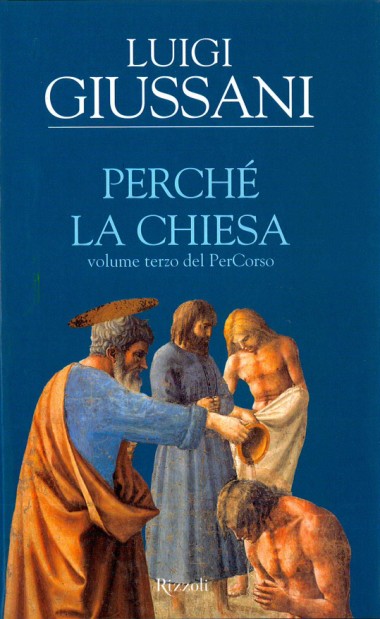

Giussani, Luigi. Perché la Chiesa: Volume terzo del PerCorso. Milano: Rizzoli, 2014.
Perché la Chiesa è il terzo ed ultimo volume del PerCorso, pubblicato da Rizzoli in veste definitiva nel 2003. L’opera riunisce i due tomi precedentemente editi da Jaca Book (Perché la Chiesa: Tomo 1: La pretesa permane, 1990; Perché la Chiesa: Tomo 2: Il segno efficace del divino nella storia, 1992).
Il presente volume (Rizzoli, 2014) è una riedizione senza variazioni dell’edizione 2003, esaurita e fuori catalogo. È stata aggiornata la biografia di Giussani sulle alette.
Il volume si apre con la “Prefazione alla nuova edizione” appositamente redatta dall’Autore per l’edizione del 2003 (pp. I-II).
Lo scritto Perché la Chiesa: Tomo 1: La pretesa permane è pubblicato per la prima volta nel 1990 dalla casa editrice Jaca Book. Due anni dopo esce il secondo tomo, sottotitolato Il segno efficace del divino nella storia.
I temi affrontati in modo approfondito in questi due tomi erano già stati accennati dall’Autore nelle primissime pubblicazioni del Senso religioso (GIAC, 1957, nei capitoli “Dov’è ora Cristo” e “Chiesa: verità e vita”, pp. 22-32 e Jaca Book, 1966 nella “Parte quarta. Presenza e storia”, pp. 75-92; riedizione 1977, pp. 81-100). Negli anni 1965 e 1966 circolavano inoltre alcuni appunti intitolati Schema del corso della Chiesa (sintesi di incontri organizzati dal centro culturale Charles Péguy di Milano) e per l’anno accademico 1976-1977 era stata diffusa una dispensa per gli studenti di Introduzione alla Teologia dell’Università Cattolica di Milano, corso di cui Giussani era incaricato (Schema per un corso sulla Chiesa: Appunti presi a cura degli studenti, Cooperativa Universitaria Studio e Lavoro). Entrambi gli scritti sono il compendio delle sue lezioni e contengono in nuce ciò che l’Autore ha in seguito dettagliato in Perché la Chiesa.
Appartengono alla Trilogia Il senso religioso. Jaca Book, 1986 e All’origine della pretesa cristiana. Jaca Book, 1988.
Nel 1994 la casa editrice Jaca Book ripropone i testi nel primo dei due volumi che raccolgono gli scritti dell’Autore pubblicati sotto il suo marchio (Opere 1966-1992: Vol. 1: Il PerCorso, pp. 329-617).
Nell’ottobre 2001 entrambi i tomi, esauriti nelle edizioni Jaca Book del 1990 e 1992, sono editati da Cooperativa Editoriale Nuovo Mondo in volume unico.
Nel 2003 i due testi sono rieditati da Rizzoli in veste definitiva in volume unico con il titolo Perché la Chiesa: volume terzo del PerCorso.
In occasione della ripubblicazione è stato operato un importante lavoro di revisione delle edizioni Jaca Book 1990 e 1992. L’Autore ha riesaminato i testi ripristinando e reintroducendo esempi e materiali da lui frequentemente utilizzati a lezione, così da rendere lo scritto più chiaro e immediato, pur mantenendo l’impianto originario.
Il volume di Rizzoli è strutturato in due sezioni (“Sezione prima. La pretesa permane”, pp. 1-149 e “Sezione seconda. Il segno efficace del divino nella storia”, pp. 151-312) che corrispondono ai tomi delle edizioni 1990 e 1992.
La “Prefazione alla nuova edizione” (pp. V-VI) è stata scritta dall’Autore nel settembre 2003, in essa è indicato il motivo dell’aggiunta del capitolo conclusivo su Maria di Nazareth (“Se’ di speranza fontana vivace”, 2003, pp. 307-310). Il testo di questo capitolo è stato pubblicato dalla rivista Vita e Pensiero con il titolo “Maria, da quel soffio è dipeso il destino del mondo” (5 2003: pp. 89-91).
Quella che nell’edizione Jaca Book era l’“Introduzione” al primo tomo (Jaca Book, 1990, pp. 7-79) è ora parte della prima sezione e si intitola “Parte prima. Al cuore del problema Chiesa” (1997, pp. 3-77). Segue la “Parte seconda. I fattori costitutivi del fenomeno cristiano nella storia” (1997, pp. 79-148).
Nella “Sezione seconda”, il paragrafo intitolato “Santità” (nel capitolo “Dal frutto si conosce l’albero”, pp. 283-306) ha subito importanti modifiche: molti concetti sono stati approfonditi e sono stati inseriti due ampi esempi. Il primo (sull’episodio della gioventù di Giussani riguardante il dizionario Gemoll, Rizzoli, 2003, pp. 288-290) compare anche nell’intervento dell’Autore pubblicato nel volume di Julián Carrón e Francesco Ventorino Parole ai preti (SEI, 1996, pp. 156-157). Il secondo racconta la guarigione miracolosa di Pietro de Rudder (Rizzoli, 2003, pp. 291-294). L’argomento era stato trattato anche da Alberto Savorana nell’articolo “Oostacker, 7 aprile 1875” (in Litterae Communionis-Tracce, 8 1995: pp. 36-38).
Molti cambiamenti (tagli, aggiunte, modifiche) interessano le citazioni di opere di autori diversi (la maggior parte di esse sono state espunte dal testo e portate in nota per favorire la scorrevolezza dello scritto di Giussani); è stata inoltre verificata l’esattezza delle stesse attraverso il confronto con i testi di riferimento in commercio. L’intero apparato note ha subito ampie modifiche.
Il volume si chiude con il breve capitolo “Alla fine del percorso” (pp. 311-312) dal quale è stata espunta la citazione di un brano di Bernhard Welte (Jaca Book, 1992, pp. 145-147).
L’opera, nella nuova veste Rizzoli (2003), è stata presentata il 2 febbraio 2004 presso l’Auditorium di Milano; l’evento fu organizzato con l’occasione del cinquantesimo anniversario della nascita di Comunione e Liberazione.
Gli interventi di Stefano Alberto, Claudio Morpurgo e Archie Spencer sono pubblicati in Un esempio di ecumenismo: Presentazione del libro di Luigi Giussani «Perché la Chiesa»: Edizioni Rizzoli, opuscolo edito come supplemento a Litterae Communionis-Tracce (3, 2004).
Da aprile 2005 il libro è disponibile anche in edizione economica BUR (ristampe 2007 e 2015 nella collana BUR “Saggi”, rinnovata la veste grafica della copertina).
Nel 2007, per iniziativa editoriale di Rizzoli, l’opera è pubblicata nel volume L’itinerario della fede che ripropone integralmente Il PerCorso (“Perché la Chiesa [2003]”, in Rizzoli, 2007, pp. 311-582).
Per iniziativa editoriale di RCS: Corriere della Sera, il 5 marzo 2016 Perché la Chiesa esce in abbinamento al quotidiano nella collana “I manuali del Corriere della Sera”. Si tratta del secondo di dieci volumi dell’Autore in edicola settimanalmente.
Ogni volume è introdotto da una nuova presentazione; per Perché la Chiesa il testo è il Prólogo, inedito in lingua italiana, scritto dell’allora arcivescovo di Buenos Aires Jorge Mario Bergoglio (Buenos Aires, 1° de mayo de 2005. Fiesta de San José Obrero) in occasione dell’edizione in lingua spagnola per l'Argentina del volume di Giussani (BUR, 2016, pp. V-VII; Lohlé: Ediciones Encuentro: Prólogo. In Por qué la Iglesia. Buenos Aires; Madrid, 2005, pp. 5-7). Il testo fu presentato, con la partecipazione dell’Arcivescovo stesso, il 15 giugno 2005 (Buenos Aires, Auditorio de la Fundación Banco Río).
Il testo di Giussani è una ristampa conforme all’originale dell’edizione Rizzoli, 2014 di Perchè la Chiesa: Volume terzo del PerCorso, inclusa la “Prefazione” dell’Autore per l’edizione 2003 (2016, pp. IX-X; 2003 e 2014, pp. I-II).
Le parti dell’opera Perchè la Chiesa intitolate “Come la Chiesa ha definito se stessa” e “La verifica della presenza del divino nella vita della Chiesa” (che costituiscono il secondo tomo dell’edizione Jaca Book, 1992; Rizzoli, 2003, pp. 159-312) sono state oggetto di riflessione approfondita in conversazioni fra l’Autore e alcuni membri dell’associazione Memores Domini raccolte nella collana “Quasi Tischreden”, principalmente in Una presenza che cambia (BUR, 2004, T106-107, T115, T118, T121-122, T124, T 126-128, T 130-133, T143, T146), ma anche in «Tu» (o dell’amicizia) (BUR, 1997, T120), Vivendo nella carne (BUR, 1998, T112, T144-145, T150, T155), L’attrattiva Gesù (BUR, 1999, T113, T123, T149; nuova edizione BUR Rizzoli, 2025), L’autocoscienza del cosmo (BUR, 2000, T110, T148), Affezione e dimora (BUR, 2001, T114) e Dal temperamento un metodo (BUR, 2002, T109, T154). [P. M.]
The book addresses the problem of our relationship with Christ in the present. Two thousand years later Christ reaches out to humankind through a reality that can be seen and touched, the unity of those who have been grasped by Him and who recognize Him—the Church.
Book One—The Claim Continues
Part One—At the Heart of the Church Problem
Part One answers the question, “How can I, who arrived the day after Christ left, know that this really is Something of supreme interest to me?” Historically, three different answers have been given, describing as many chapters in the cultural history of the West and, at the same time, indicating three attitudes with which people today can view the Christian proposal. The first approach, the historical-rationalistic approach, views Christianity as a fact of the past and gathers information from the past to reconstruct the life of Jesus. The second method, which can be called the “Protestant” attitude, relies on an inner enlightenment, considering it impossible for the divine to make itself present through human reality. Both methods, seemingly opposed to each other, have a common denominator—they reduce the Christian fact to a subjectivistic phenomenon. The third possible approach, the Orthodox-Catholic approach, is faithful to the dynamic that occurred two thousand years ago—to know Christ, God made flesh, a human encounter is necessary. It also values the main aspects of the first two methods, promoting historical inquiry, which can be fully understood only from within a present experience, and exalting the possibility of a personal relationship with Christ, which is realized to the fullest extent in front of the carnal presence of the Mystery.
Today, a lack of attunement with Christian words makes them extraneous to mankind; this is an option permanently open to the human soul, characterized by a lack of committed interest, and an absence of curiosity toward reality. But it is also the outcome of a long historical path of forgetfulness of the religious aspect. While Medieval times were basically characterized by easily perceiving God as a present and decisive factor in every aspect of life, a process of the disarticulation of the unitary religious mentality developed in later centuries. The extreme exaltation of man and his abilities is the common denominator of the different historical and cultural stages (Humanism, Renaissance, rationalism); the exaltation not of man in his personal concreteness, but of humanity abstractly understood. As it intensifies, such exaltation flows into scientism, an unlimited trust in scientific progress regarded as the solution to the human problem. Today, people easily acknowledge God providing it is clear that God has nothing to do with human reality—this is the secularist culture, for which life is conceived and lived as if God did not exist.
Part Two—The Constituent Factors of the Christian Phenomenon in History
The Church presented and presents itself in history as a relationship with the living Christ. After Christ’s resurrection, the group of those who had followed him is strengthened, not by virtue of a memory, but because the risen Christ makes Himself present among them. There is, then, a physiological continuity between Christ and this first nucleus of the Church—this journey begins in the world as permanence of the life of the man Christ. There are three constituent factors of this phenomenon.
It is a sociologically identifiable reality, a visible group, called by the term Ecclesia Dei, those gathered by God as chosen by Him. The Christian idea of belonging no longer has, as for the Hebrew people, an ethnic aspect—it is the group of all those whom God unites through faith in Jesus Christ.
Second, the first Christians are aware that everything exceptional that happens in them is not the fruit of their adherence, of their intelligence or will, but a mysterious gift of the Spirit, of a “Strength from on High” with which they are invested.
Finally, the Christian fact starts a new type of life, described in the New Testament by the term koinonia (communion), which means a group of people who share something. The first Christians share their reason for living, Christ. Communion is expressed in an ethical ideal, the tendency to share all material and spiritual resources, thus pointing to a new institutional phenomenon within society; it carries with it a ritual expression, the Eucharistic Act as the supreme, distinctive mark of faith in Jesus Christ; and it is marked by a “hierarchical factor,” since at the basis of Jesus’ precise teaching, the Church was founded on the apostles, grounded in the special primacy of Peter. To conclude, the early Christians communities called themselves communities of saints, people who were part of God’s Covenant with man and followed the pathway of life according to His will.
Book Two—The Effective Sign of the Divine in History
Part One—The Church’s Self-Definition
The Church’s claim that it is the vehicle of the divine working through human reality is Christ’s own claim—a man whose identity presented nothing mysterious at first sight and claiming to be God caused great scandal from the start. The apostle Paul was aware of the innate disproportion in the phenomenon of the “Church”—a highly fragile humanity destined to reveal the invincibility of a Presence that uses man but comes not from man. This implies that God uses various temperaments and mentalities to communicate the different aspects of the truth and that everything depends on human freedom, with no shock at the behavioral limitations of men. Moreover, God communicates Himself through the environment and the historical-cultural moment—thus, the structure of the Church always notably bears the mental and cultural mark of the age in which it operates. However, as opposed to other structures, the accentuation of a factor will never be able to elude the presence of the truth in its entirety.
The purpose of the Church in the world and in history has the same purpose as Jesus—to educate all men and women towards their own destiny in terms of consciousness and their attempt to live it correctly. On the one hand, the Church claims to be able to have the definitive word on man and history, stressing that the person–who can be exploited by no one—cannot be reduced to any scheme or category, and points to the kingdom of God as the meaning towards which all of life’s fragments reach out. On the other hand, the Church has never forgotten this, its educational vocation, its concern that men and women should live in the awareness of being totally dependent on the Mystery. In the face of problems, which are the fabric of our life, the Church does not aim to solve them, to take them away from human freedom and creativity, but indicates the best position to adopt for facing them.
The divine communicates itself in the Church as the transmission of the truth—God, through the Church, helps man to attain objective clarity and security in his perception of all the ultimate meanings of his existence. Man, on his own, can only reach the threshold of the meaning of existence and ask, perhaps implicitly or unconsciously, for divine help in his searching; or he might ask more explicitly that the divine reveal itself. The Christian message fulfills what often surfaces in man’s conscience as presentiment or prophecy—that all things in history are redeemable. This communication of truth comes about in the Church either through an ordinary way, the life of the community bound to the ordinary magisterium of the Pope and the bishops in communion with him, or through the extraordinary magisterium, which happens when the Pope states something with all the authority at his command (by convening an Ecumenical Council or by an ex cathedra definition).
The expression in the Gospel of John “the Word was made flesh” shows that we do not find ourselves simply in front of the communication of truth. No, we are before the communication of the divine itself. This occurs through an ontological “exaltation” of the “I,” (the “new man” that we find in the Gospel), a leap in quality in the participation of Being. It is the action of sanctifying grace, a gratuitous gift that makes us adhere to God. This supernatural grace communicates itself by means of concrete gestures, the sacraments, which prolong in history the signs Christ used to communicate himself.
Part. Two—Verifying the Presence of the Divine in the Life of the Church
How can one be certain that the Church is truly the prolongation of Christ in time and space? Four “fruits” show the divine value of the Church and its continuing effectiveness in history.
Unity, that is, a simplicity uniting our feeling and judgment of life. This is possible because the principle behind our judgment of ourselves and the world is the one unequivocal Presence.
Holiness, not understood as a separation from our ordinary daily life, but as the prerogative of the self-fulfilled person, who lives and acts in the awareness of the ultimate motivation for his or her action.
Catholicity (from the Greek katholikós, universal), a dimension of the Church expressing its pertinence to human matters and all the variegated forms they take.
Finally, apostolicity, according to which the Church affirms itself as the only authority to be the custodian of a tradition of values and realities deriving from the apostles. Just as Christ’s will was to bind his work and his presence in the world to the apostles and in doing so he indicated one of them as the authoritative point of reference, so, too, is the Church bound to Peter’s and the apostles’ successors—the Pope and his bishops.
But we cannot speak of the Church without looking at the woman from whom it is born and continues to be born, Mary, mother of Christ. That is why Mary is the mother of the living, and for all men and women happiness passes and will pass through her flesh and, even before that, through her fiat, “Let it be.” Thus, the most concise and suggestive formula expressing the Church’s self-awareness as the permanence of Christ in history is: Veni Sancte Spiritus, veni per Mariam.
