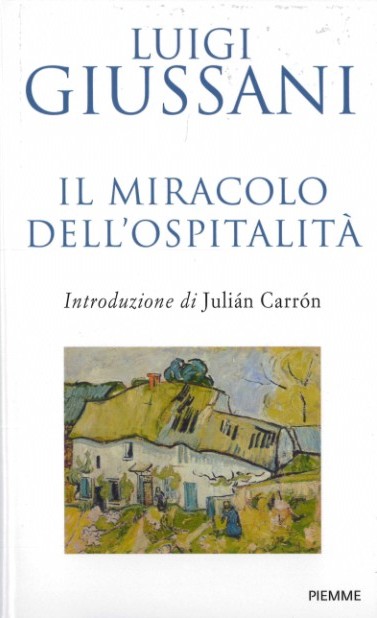
Giussani, Luigi. Il miracolo dell’ospitalità: Conversazioni con le Famiglie per l’Accoglienza. Introduzione di Julián Carrón. Milano: PIEMME, 2012.

Il miracolo dell'ospitalità: Conversazioni con le Famiglie per l'Accoglienza
Carrón Julián  Introduction
Giussani Luigi  Author
Massari Carla  Contribution

PIEMME Italian 2012 Pages: 168

Latest update
16/04/2026


Giussani, Luigi. Il miracolo dell’ospitalità: Conversazioni con le Famiglie per l’Accoglienza. Introduzione di Julián Carrón. Milano: PIEMME, 2012.


Read the full text of the available edition

2025 - Il miracolo dell'ospitalità: Conversazioni con le Famiglie per l'Accoglienza - PIEMME - Italiano

Editorial History

Edizione ampliata e aggiornata del volume Il miracolo dell’ospitalità: Conversazioni con le Famiglie per l’Accoglienza pubblicato per la prima volta da PIEMME nel 2003. La miscellanea raccoglie interventi e dialoghi fra Giussani e i membri dell’Associazione Famiglie per l’Accoglienza diffusa in tutta Italia e da molti anni impegnata nel promuovere l’affido e l’adozione, sostenendo le famiglie che vi aderiscono.

L’opera si apre con l’Introduzione di Julián Carrón appositamente redatta per la presente edizione (pp. 7-12).
Segue un messaggio di Giussani “Alle Famiglie per l’Accoglienza” già parte dell’edizione del 2003 (p. 13; 2003, p. 7). Si tratta del messaggio che l’Autore ha fatto pervenire ai responsabili dell’Associazione in occasione dell’assemblea svoltasi a Milano nel giugno 2002, pubblicato per la prima volta in Lettera periodica, strumento di informazione delle Famiglie per l’Accoglienza (“Segno di una novità che si dilata di famiglia in famiglia”, 6, 2002: p. 1). 
Nel 2007, il testo del messaggio è rieditato senza variazioni nel volume L’eroico quotidiano (Cantagalli, 2007, p. 5). 
Nel giugno 2022, in occasione dei quarant’anni dell’Associazione, lo scritto è riproposto con il titolo “Alle Famiglie per l’Accoglienza” in Lettera Periodica (113, 2022: p. 3). Nel successivo mese di agosto, è posto a conclusione del catalogo intitolato Non “come” ma “quello”: Artisti e famiglie nella sorpresa della gratuità (Itaca, 2022, p. 118), realizzato in occasione della mostra omonima a cura di Famiglie per l’Accoglienza ed esposta alla XLIII edizione del Meeting per l’amicizia fra i popoli (Rimini, 20-25 agosto 2022).

Il primo capitolo, “La ragione della carità” (pp. 15-23; 2003, pp. 9-17), è l’intervento dell’Autore al primo Convegno nazionale dell’Associazione, svoltosi a Milano l’8 giugno 1985.
Il testo è pubblicato per la prima volta con il titolo “Fondamenti antropologici e metodologici della condivisione” nel volume Accoglienza volto del gratuito: Atti del Convegno dell’Associazione: Milano 8 giugno 1985 (EDIT Editoriale Italiana, 1985, pp. 1-9).
Nel 1991, lo scritto è rieditato in CL-Litterae Communionis con il titolo “I fondamenti della condivisione” (2, 1991: inserto); rispetto all’edizione EDIT 1985, il testo è stato suddiviso in paragrafi con titoli propri e sono state espunte alcune parti dell’intervento, in particolare non è riportata buona parte di p. 8 e manca del tutto p. 9. 
Nel 2001, il testo, nella forma editata nel 1985, è riproposto integralmente in Buone Notizie (3, 2001: pp. 7-10), rivista trimestrale di AVSI (Associazione Volontari per il Servizio Internazionale), con il titolo “La ragione della carità” (lievissime modifiche di carattere redazionale, aggiunte alcune righe in fondo a p. 10). 
In quest’ultima forma è pubblicato nel presente volume (espunte le righe conclusive precedentemente aggiunte in Buone Notizie, 2001).

I due capitoli che seguono riguardano la Giornata d’inizio anno per gli adulti di Comunione e Liberazione della diocesi di Milano, svoltasi il 2 ottobre 1988:
- “Vivere nella gratuità” (pp. 25-40; 2003, pp. 18-33) è l’intervento integrale dell’Autore, pubblicato in CL-Litterae Communionis (11, 1988: pp. 4-8. Con successive traduzioni), in forma sintetica e con una diversa titolazione dei paragrafi rispetto alla versione più ampia edita nel presente volume; il titolo è invariato. 
- “Un’esperienza nuova dell’umano” (pp. 41-51; 2003, pp. 34-44) è un dialogo tra l’Autore e i membri dell’Associazione avvenuto nel pomeriggio (cfr. nota 1, p. 41).

“«Non da carne, né da sangue, ma da Dio siamo nati»” (pp. 53-61; 2003, pp. 45-53) è il testo di una conversazione con il Direttivo Famiglie per l’Accoglienza svoltasi a Milano il 4 Giugno 1989.

I due capitoli successivi riportano appunti da conversazioni tra Giussani e i membri del Direttivo Nazionale dell’Associazione, che si sono svolte a Milano: 
- “L’abbraccio del diverso” (pp. 63-72; 2003, pp. 54-63), dialogo avvenuto il 22 giugno 1991;
- “L’imitazione di Cristo” (pp. 73-86; 2003, pp. 64-77), conversazione del 7 novembre 1992.

“La familiarità come metodo del Mistero” (pp. 87-103; 2003, pp. 78-94) è il testo integrale dell’incontro con il Direttivo avvenuto il 28 Gennaio 1996, in parte già editato in Litterae Communionis-Tracce (“«La testimonianza è una realtà umana, nel senso totale e banale del termine». Le Famiglie per l’accoglienza, una eccezionalità in un comportamento normale. Dall’ultimo numero della loro newsletter”, 5, 1996: pp. 73-74. Con successiva traduzione).

La sezione “Appendici” (pp. 105-131; 2003, pp. 95-120) consta di due testi:
- “La persona, soggetto del rapporto” (pp. 107-117; 2003, pp. 97-107), appunti da una conversazione sulla famiglia, tenutasi a Milano nel 1972;
- “Cultura della vita e cultura della morte” (pp. 119-131; 2003, pp. 108-120), intervento al Congresso Internazionale Teologico-Pastorale sul tema “I figli, primavera della famiglia e della società”, organizzato dal Pontificio Consiglio per la Famiglia in occasione del Giubileo della Famiglia (Roma, 10-12 ottobre 2000). 
A conclusione del Congresso il testo fu pubblicato in Litterae Communionis-Tracce con il titolo “Cultura della vita e cultura della morte” (10, 2000: pp. 15-27. Con successive traduzioni); i quattro punti principali del discorso sono evidenziati da alcune righe introduttive che ne riassumono il contenuto.
L’anno successivo lo scritto è riproposto identico in I figli: famiglia e società del nuovo millennio: Atti del Congresso Internazionale Teologico-Pastorale: Città del Vaticano, 11-13 ottobre 2000 (Libreria Editrice Vaticana, 2001, pp. 289-297).
Nel 2012, in occasione dell’uscita nelle librerie del presente volume, lo scritto è pubblicato in formato pdf sul sito di Comunione e Liberazione (https://it.clonline.org/news/attualit%C3%A0/2022/06/22/don-giussani-meeting-1985. Url non più attivo dal 2016).

Conclude l’opera la Nota storica (pp. 135-159; 2003, pp. 121-138) a cura di Carla Massari, già presente nell’edizione del 2003, qui aggiornata e ampliata con una nuova sezione dal titolo “Una compagnia in cammino: gli sviluppi dal 2002 al 2012” (pp. 150-159). 

Nel 2025, nel ventesimo anniversario della scomparsa dell’Autore, PIEMME riedita il volume con una nuova postfazione di Davide Prosperi, presidente della Fraternità di Comunione e Liberazione (La forza di una testimonianza, 2025, pp. 149-191); ampliata la Nota storica e aggiornate le note a piè di pagina. Il testo dell’Autore non ha subito modifiche. [C. C.]

Summary of contents

The Reason for Charity
Normally the reasons for sharing life are experienced implicitly in our good will, but the more aware we are of the aims from which this gesture comes from, the clearer and more joyful our act of charity will be. The root of gratuitousness lies in the fact that everything we do and everything we are is given; by achieving it we participate in the very life of the Mystery. We can draw three conclusions from this—the awareness of being loved, forgiving difference, and love for the person. The methodological factors of this itinerary can be summed up in the exercise of freedom where humility is rooted and in accommodation, which is love for the other, without pretense, and love of suffering. For gratuitousness, in practice, springs from this suffering, from this lack of correspondence that is at the root of any relationship, because only in the Eternal can we find true correspondence.

Living Gratuitousness
In front of the Mystery that was persuasively communicated through the concreteness of a story, in an act of absolute gratuitousness—“With age-old love I have loved you; so I have kept my mercy toward you”—we cannot but wish to imitate Him in His charity. Gratuitousness means facing our relationship with ourselves, and with everything else, in the light of destiny, that is in the light of Christ—the source of this criterion is gratitude for the charity with which Christ has touched our lives. The most impressive aspect of gratuitousness is the life of Christian companionship, because it is sewn together by one thing—Christ.

A New Experience of Humanity
We understand and know that Jesus Christ is a factor in reality when we realize that we change the way we relate to things because of our awareness of Christ—in fact, He is a new experience of humanity. “With the experience of welcoming, it is as if no one needs even to explain who Jesus Christ is; you see Him clearly in the gesture.” This experience of welcoming stands as the most symptomatic fact from the point of view of maturity in our life—it is primarily a personal problem, not an operational one.

“Not of Flesh, Nor of Blood, but of God Are We Born”
Recognizing the fact that unites us, our greatest human and Christian work is that the peculiarity and individuality of our family could open itself to the point of welcoming what, humanly speaking, seems strange. The work of “Welcoming Families” testifies the characteristics of the Christian family, that is family in its truth. The first characteristic is a capacity for hospitality, the implication of your whole self in the relationship with a child who has nothing to do with your own flesh and blood. The second is a capacity for forgiveness, in which the acceptance of difficulty can succeed only insofar as the first communionality is experienced among the “Welcoming Families.” Freedom from the outcome and joy in sacrifice spring from our experience of faith, from recognizing that we are loved, accepted, “We love because we are loved.”

Embracing What Is Different
“Welcoming Families” is not first of all an organization, but an experience. Experience is a connection with the Mystery made man, and the more one penetrates it by welcoming it, the more this enlarges itself—the companionship that is born from experience is a friendship that translates the relationship with Christ into fleeting terms, but of no fleeting value. Practicing hospitality means welcoming the way in which God has become a presence in your life; therefore, it is welcoming something different. For there is no greater difference than that between being and nothingness, between God made man and the man who is a sinner. Pure gratuitousness in an embrace, therefore, would be impossible if we were not moved by the love for Christ, by imitating Him. Therefore, this work is like a flag, a sign that calls everyone into what we are fighting for—for humanity, for eternity.

The Imitation of Christ
In the phenomenon of welcoming, the whole mystery of the Trinity reverberates, because the mystery of the Trinity represents an infinite hospitality. The value of hospitality lies in the all-encompassing openness of the heart that offers itself to imitate the love of God, and it is not distorted by the temporal limit of the fostering. In fact, God is the totalizing reason—charity is the answer to the gratuitousness that created us and came to “be with” every one of us. Love is all-encompassing, therefore, when you welcome the other according to the totality of her being, you accept and sustain her in everything that she lives, imitating the love of God for her. But we cannot do anything on our own; we need to ask the Virgin Mary for the grace to know how to welcome what is given to us and help each other live out the very aim of the association.

Familiarity as the Method of the Mystery
The method the apostles used to get to the limits of the earth was witnessing a new humanity that anyone could observe—a real experience that carried within itself something exceptional and aroused amazement. This exceptionality coincides with what Christianity calls a miracle—the forward movement of the divine footstep within the steps of a human companionship. In fact, God chose as His method for educating man to His will a total familiarity with man. There is no other event that can make us feel like brothers and sisters like the fact that this Mystery who is among us brings every day a superabundant testimony of Himself—this certainty about the presence of the Lord makes us capable of anything.

Appendices

The Person, Subject of a Relationship
In addressing the phenomenon of the man-woman relationship, three main points are made—the value of the person, function and the social and historical context. Marriage implies a rising-above this very phenomenon because a person is not made for marriage, but for Destiny. The person is called, in the work that he takes on, to carry out a task, that is, a moment within the total design; and the affective event is nothing but the modality with which a man carries himself toward the world. In fact, the person, in carrying out his or her function, is present within a certain social context, which will always tend to exploit the family in some way by attempting to divide the meaning of the life of the parents from that of the children. The Church, as it concretely affects us, represents a unique corrective and place of defense of respect for the family, which comes before the social context.

Culture of Life and Culture of Death
Death dominates the common sentiment, extending over everything the veil of appearance. This negativity leads us to exalt the passing instant of momentary satisfaction. But this attitude is not in accordance with the nature of man, who was born instead as a positive promise. The point of departure for building up a culture of life is mission, made possible by the sacrament of Baptism; so much so that marriage is a sacrament insofar as it completes the face of the missionary subject. The family fulfills its vocation through the education of children. “In raising children Christian parents must be concerned about their children’s faith and help them to fulfil the vocation God has given them” (John Paul II). However, a family cannot resist by itself. This is why we have been sent as a people—only by establishing a stable network of relationships can a family oppose itself to the dominant social network.
 

Translations

English - The Miracle of Hospitality - Giussani - Slant Books - 2023

Related publications

1985 - "Fondamenti antropologici e metodologici della condivisione." In Accoglienza volto del gratuito: Atti del Convegno dell'Associazione: Milano 8 giugno 1985 - Giussani - EDIT Editoriale Italiana - Italian
1988 - Vivere nella gratuità - Giussani - CL-Litterae Communionis - Italian
1991 - I fondamenti della condivisione - Giussani - CL-Litterae Communionis - Italian
1996 - «La testimonianza è una realtà umana, nel senso totale e banale del termine». Le Famiglie per l'accoglienza, una eccezionalità in un comportamento normale. Dall'ultimo numero della loro newsletter - Giussani - Litterae Communionis-Tracce - Italian
2000 - Cultura della vita e cultura della morte - Giussani - Litterae Communionis-Tracce - Italian
2001 - "Cultura della vita e cultura della morte." In I figli: famiglia e società nel nuovo millennio: Atti del Congresso Internazionale Teologico-Pastorale: Città del Vaticano, 11-13 ottobre 2000 - Giussani - Libreria Editrice Vaticana - Italian
2001 - La ragione della carità - Giussani - Buone Notizie - Italian
2003 - Il miracolo dell'ospitalità: Conversazioni con le Famiglie per l'Accoglienza - Giussani - PIEMME - Italian
2007 - "[Messaggio all'Associazione Famiglie per l'Accoglienza]." In L'eroico quotidiano - Giussani, Mazzi - Cantagalli - Italian
2012 - Introduzione a Il miracolo dell’ospitalità: Conversazioni con le Famiglie per l’Accoglienza, di Luigi Giussani - Giussani, Carrón - PIEMME - Italian
2022 - "[Messaggio in occasione del 20° della fondazione di Famiglie per l'Accoglienza]." In Non "come" ma "quello": Artisti e famiglie nella sorpresa della gratuità, a cura di Giorgio Paolucci - Giussani, Paolucci, Zamagni - Itaca - Italian
2025 - Il miracolo dell'ospitalità: Conversazioni con le Famiglie per l'Accoglienza - Giussani, Carrón, Prosperi - PIEMME - Italian

Translations of Related Publications

French - Culture de la vie et culture de la mort - Giussani - Litterae Communionis-Traces - 2000
English - Culture of Life and Culture of Death - Giussani - Litterae Communionis-Traces - 2000
English - Introduction to The Miracle of Hospitality, by Luigi Giussani - Giussani, Carrón - Slant Books - 2023
Portuguese - Viver na gratuidade - Giussani - CL-Litterae Communionis Portugal - 1991
Portoghese BR - Viver na gratuidade - Giussani - CL-Comunhão e Libertação - 1989
Portoghese BR - Testemunho de uma realidade humana - Giussani - Litterae Communionis-CL - 1996
Portoghese BR - Cultura da vida e cultura da morte - Giussani - Litterae Communionis-Passos - 2000
Portoghese BR - A Razão da Caridade - Giussani - Litterae Communionis-Passos edição brasileira - 2006
Portoghese BR - O milagre da hospitalidade: Diálogos com as Famílias para a Acolhida - Giussani - Editora Companhia Ilimitada - 2006
Spanish - Vivir en la gratuidad - Giussani - Nueva Tierra - 1989
Spanish - Cultura de la vida y cultura de la muerte - Giussani - Litterae Communionis-Huellas - 2000
Spanish - El milagro de la hospitalidad: Conversaciones con Familias para la Acogida - Giussani - Ediciones Encuentro - 2004
Spanish - El milagro de la hospitalidad: Conversaciones con Familias para la Acogida - Giussani - Ediciones Encuentro - 2006
German - Die Gratuität leben - Giussani - Litterae Communionis-CL - 1988

Original Text

Names

Carrón Julián  Introduction
Giussani Luigi  Author
Massari Carla  Contribution
Open in a new page


Biography
Secondary Bibliografy
Editorial Criteria
Introduction Catalogue criteria Categorization of publications Information available for each publication Full Text
INFO TO SURF THE SITE
Search and other tools Technical specifications Why register?
Updates  and  news
CONTACT US
Luigi Giussani Scritti

THE PROJECT

The portal collects and gives access to the writings of Luigi Giussani: nearly 5,000 bibliographic references, full texts in 5 languages, and dedicated thematic sections.

BROWSE

Advanced search » Il PerCorso Contact us Login

LANGUAGE

Italian English Spanish

NEWSLETTER

Get updates on new releases, events and editorial projects.

Comunione e Liberazione
Center for the Study of Giussani

© Fraternità di Comunione e Liberazione - CF 97038000580

Terms and conditions Cookies policy and preferences
en
IT EN ES
LOGIN

View details by type
Luigi Giussani
Secondary Bibliography
Scientific
Other writings

Recent activities

  • 5 October 26
    • You viewed the report ofIl miracolo dell'ospitalità: Conversazioni con le Famiglie per l'Accoglienza
A
Z
A
Z
More results
Luigi Giussani Scritti

THE PROJECT

The portal collects and gives access to the writings of Luigi Giussani: nearly 5,000 bibliographic references, full texts in 5 languages, and dedicated thematic sections.

BROWSE

Advanced search » Il PerCorso Contact us Login

LANGUAGE

Italian English Spanish

NEWSLETTER

Get updates on new releases, events and editorial projects.

Comunione e Liberazione
Center for the Study of Giussani

© Fraternità di Comunione e Liberazione - CF 97038000580

Terms and conditions Cookies policy and preferences